The Defense Advanced Research Projects Agency (DARPA) asked small companies in June 2026 to build a Rydberg-atom radio receiver that fits in less than 10 liters and draws less than 50 watts. In its topic for the project, Manufacturing Technologies for Rydberg-based Atomic Sensors (MANTRAS), DARPA wrote that the compact optics, frequency combs, and control electronics such receivers need “have yet to demonstrate the stringent performance requirements needed to supplant larger, laboratory-scale infrastructure.” DARPA solicited only “Direct-to-Phase II” proposals, which skip the usual first phase. Each applicant had to document a laboratory receiver already “showing performance comparable to, or exceeding, that of conventional antenna-based, plasmonic, or electro-optic receivers” in the application it proposed.
A Rydberg receiver senses radio waves with atoms of rubidium or cesium held in a glass cell and excited by lasers into states in which one electron orbits far from the nucleus. Two U.S. companies, Rydberg Technologies and Infleqtion, sell such receivers, which the U.S. Army has tested in field experiments.
On the evidence published through November 2026, the potential military advantage of Rydberg receivers is how much of the spectrum one centimeter-scale glass sensor can tune across, not sensitivity, where conventional receivers still lead in most bands. An Army researcher called a 2021 result “a really important step toward proving” that quantum sensors can provide a “dominant” set of capabilities. Quantum Observer found no published field comparison with conventional receivers that supports that claim.
Instantaneous bandwidth is the slice of spectrum a receiver can watch at one moment. Two teams reported 76.8 and 210 megahertz in 2025 preprints, the widest measured figures Quantum Observer found, at sensitivities four to six times poorer than that of the Shanxi University receiver described below. As an illustration of scale, a receiver with a 210-megahertz window would need about 29 separate looks to cover the band of 3 megahertz to 6 gigahertz that Infleqtion lists for its first product, before any allowance for overlap or retuning time. The 210-megahertz result came from a different research system.
What a Rydberg receiver measures
A Rydberg atom has one electron raised to a very high energy level, in an orbit far larger than the atom’s normal size. Neutral-atom quantum computers and simulators use the same states to make atoms interact, as Quantum Observer reported when Stuttgart physicists measured an 11.5-millisecond lifetime for a circular Rydberg state at room temperature.
In a 2024 article in Nature Reviews Physics, physicists at the National Institute of Standards and Technology (NIST) wrote that Rydberg atoms are “highly sensitive to electric fields because their electron wavefunction has a large spatial extent.” The atoms sense the electric part of a radio wave.
In the common design, two lasers pass through a glass cell of atomic vapor. The atoms absorb the first laser, the probe, until the second, the coupling laser, makes the vapor transparent to it. The effect is called electromagnetically induced transparency. A radio wave whose frequency matches a transition between two Rydberg levels then changes the intensity of the probe light, as DARPA described on the page for its Quantum Apertures program.
The atoms’ response depends on atomic constants that physicists can calculate. The NIST authors described the method as giving “self-calibrated and SI-traceable electric field measurements.” Such measurements are tied directly to the International System of Units without calibration against another instrument. Rydberg Technologies lists “measurement precision at the 0.1% level” for its system, which the company calls “an improvement >10x over that of classical antenna standards.”
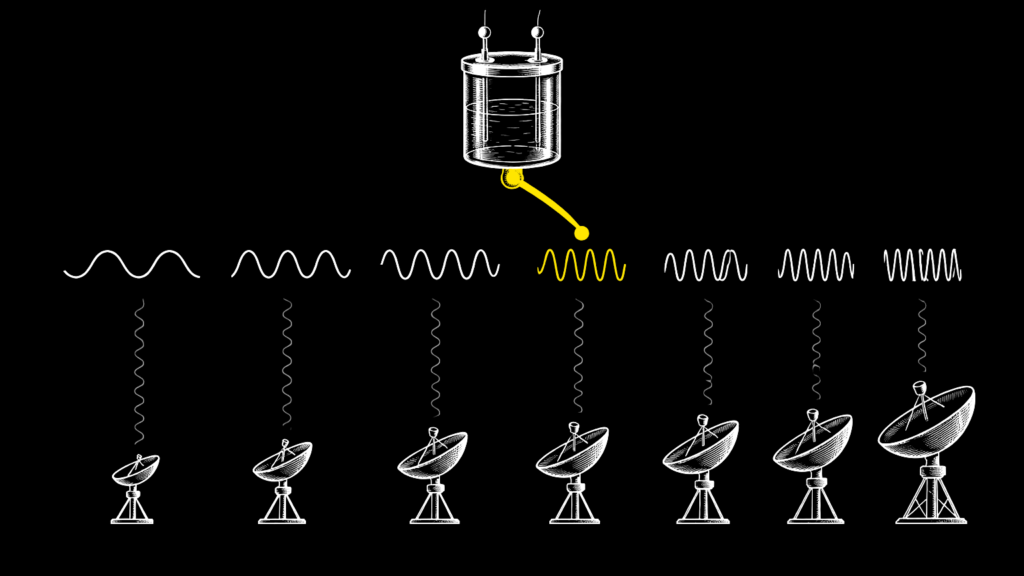
Operators choose a band by tuning the coupling laser to a different pair of Rydberg levels. Each such setting responds to one narrow band around its transition, NIST physicists wrote in a 2024 preprint.
To measure a signal’s phase and frequency as well as its strength, researchers add a reference radio wave, called a local oscillator. The atoms then mix the two signals, as the mixer stage of a conventional radio does. A Shanxi University team reported this “quantum superhet” in Nature Physics in 2020, using cesium atoms in a room-temperature vapor cell.
Sensitivity against antennas
The Shanxi team measured a sensitivity of 55 nanovolts per centimeter per root hertz. The figure is the field noise in a one-hertz measurement bandwidth, so lower is better.
Physicists at South China Normal University reported 10.0 nanovolts per centimeter per root hertz with laser-cooled rubidium atoms held in a magneto-optical trap, within a factor of 2.6 of the standard quantum limit. That limit is the floor set by the counting statistics of a given number of independent atoms. The team posted the result as a preprint in 2023 and published it in Science Advances in December 2024.
Military buyers compare a Rydberg receiver with the incumbent, an antenna connected to electronic amplifiers. Gabriel Santamaria-Botello, Zoya Popović, and two co-authors made that comparison across 600 megahertz to 330 gigahertz in a 2022 preprint. They found that “conventional room-temperature electronic receivers greatly outperform the best demonstrated sensitivities” of room-temperature Rydberg sensors in standard free-space setups. They also found that Rydberg receivers could beat conventional sensitivity if resonant microwave structures concentrated the field at the atoms.
Two teams have since built such structures. Georgia Sandidge and Popović of the University of Colorado Boulder, with Santamaria-Botello and two Infleqtion researchers, reported in IEEE Transactions on Microwave Theory and Techniques in April 2024 that a resonant cavity improved a room-temperature receiver’s sensitivity at 10.22 gigahertz from 23 to 1.58 microvolts per meter per root hertz. In the units used above, that is an improvement from 230 to 15.8 nanovolts per centimeter per root hertz.
The Colorado team wrote that its improved receiver corresponds to a low-noise amplifier with a noise figure of 19.23 decibels, down from 42.44 decibels without the cavity. Noise figure measures how much noise a receiver adds to a signal, so lower is better. In their 2022 comparison, Santamaria-Botello’s team cited an off-the-shelf room-temperature amplifier for that band with a noise figure of 1.3 decibels.
At the University of Science and Technology of China (USTC), Bang Liu, Dong-Sheng Ding, Bao-Sen Shi, and colleagues reported in a 2024 preprint “an 18 dB enhancement of power sensitivity” from placing the vapor cell inside a microwave cavity. They projected that a cavity with a far higher quality factor, a measure of how long it stores energy, could surpass “the thermal noise limit of conventional antennas.” They made no measured comparison with a conventional receiver.
K. M. Backes, Kevin Cox, and colleagues at the Army’s DEVCOM Army Research Laboratory compared centimeter-scale Rydberg sensors with room-temperature antennas of similar size at low frequencies, where such antennas are much smaller than a wavelength. In Applied Physics Letters in September 2024, they reported that current Rydberg sensors are less sensitive than small antennas with active amplification and no impedance matching. An idealized Rydberg sensor at the standard quantum limit could outperform such antennas by a wide margin, they calculated.
The Army team also found that, in the regime it studied, both kinds of sensor resolve fields weaker than the typical radio noise of the atmosphere. Natural noise then sets the weakest usable signal for any receiver. The team did not compare either sensor with a larger antenna. On Quantum Observer’s reading, a buyer gains little from extra sensitivity where atmospheric noise sets the floor, so a small Rydberg sensor’s main advantage at these frequencies is its size.
Infleqtion is aiming its UK work at that regime. Its UK unit won £9 million from Innovate UK in October 2026 for a deployable direction finder for high-frequency (HF) radio, according to a company release. The company said the system is designed to reduce reliance on large antenna arrays at lower frequencies. The UK government listed the unit among the winners under Infleqtion’s former name, ColdQuanta UK, and described its project as a compact, mobile radio “antenna” for locating signals.
Coverage and instantaneous bandwidth
In 2021, Army Research Laboratory researchers David Meyer, Paul Kunz, and Kevin Cox reported in Physical Review Applied a Rydberg spectrum analyzer that detected signals from zero frequency to 20 gigahertz, including AM and FM radio, Bluetooth, and Wi-Fi. Cox said the sensor “operates continuously over a wide frequency range for the first time.”
Durham University physicists Gianluca Allinson, Stuart Adams, Kevin Weatherill, and colleagues detected a series of amplitude-modulated tones at the same time in one receiver, on carriers spread from 128 megahertz to 0.61 terahertz. The team received each tone on its own carrier at a separate point in that span and did not report continuous coverage between them. They reported the result in Physical Review Research in June 2024.
At NIST, Nikunjkumar Prajapati, Christopher Holloway, and colleagues used an optical frequency comb, a laser with many evenly spaced frequencies, as the coupling laser. With it, they prepared up to seven Rydberg states at once, for detection across 1 to 40 gigahertz. They published the result in Nature Communications in December 2025.
Both companies quote wide spans for their products. In its May 2026 launch release, Infleqtion said its Quantum Spectrum receivers use “atom-based detection that tunes continuously from hertz to terahertz across the full RF spectrum in a single aperture.” On its product page, Infleqtion lists the first-generation receiver at 3 megahertz to 6 gigahertz and a second generation at 1 megahertz to 12 gigahertz, with custom systems from 100 kilohertz to 100 gigahertz. Rydberg Technologies says its system covers frequencies from near zero to millimeter waves, “over three times the coverage of a typical probe antenna.”
The instantaneous bandwidth of these receivers is far narrower than their tuning range. In a 2024 preprint, NIST researchers reported a bandwidth “as high as 12+/-1 MHz” with a frequency comb as the probe laser. They described the result as a dramatic improvement.
Two teams went further in 2025 preprints. Yuhan Yan, Huadong Cheng, and colleagues reported what they called “a record instantaneous bandwidth,” 76.8 megahertz, from a thermal rubidium vapor sensor, at a sensitivity of 222.6 nanovolts per centimeter per root hertz. Yuechun Jiao, Jianming Zhao, and colleagues reported 210 megahertz at 326.6 nanovolts per centimeter per root hertz. They used “a linear array of scalable Rydberg vapor cells,” with each line of a 21-line microwave comb coupled to one cell.
The two teams reached those bandwidths at sensitivities about four and six times poorer than the Shanxi receiver’s 55 nanovolts. As of November 2026, arXiv listed no journal publication for either preprint. In a preprint revised in September 2026, Huizhi Wang, Emil Björnson, and two co-authors calculated that a multi-carrier design could reach 11.7 megahertz, 17 times the bandwidth they gave for conventional Rydberg receivers. They obtained the figure by simulation and reported no measurement.
USTC researchers wrote in a July 2026 preprint that Rydberg receivers are limited by “narrow instantaneous bandwidth.” They cited an “intrinsic atomic bandwidth of 126 kHz.” To survey more than 640 megahertz, they used compressive sensing, a sampling method for sparse signals. Neither company publishes an instantaneous bandwidth for its product.
Seven of the July preprint’s authors, including Dong-Sheng Ding, also wrote a June 2026 preprint on a frequency-hopping radio link through a Rydberg receiver. The link covered 100 kilohertz to 20 gigahertz with “a hopping rate of 100 khop/s,” or 100,000 hops per second. In the abstract, the authors reported “a 51 dB enhancement in narrowband interference tolerance compared with single-frequency systems.” In the body of the paper, they gave figures from 16 to 51 dBm against different baselines, including 32 dBm against single-frequency systems. Decibels express a ratio and dBm an absolute power level, so the two sets of figures are not stated in the same terms.
The receiver’s local oscillator followed the same predetermined hopping sequence as the transmitter, so the authors did not demonstrate interception of an unknown signal.
Size, weight, and power
The authors of a 2024 review in the Chinese journal High Power Laser and Particle Beams wrote that the sensing element is small and that the atoms are not limited by the size effects of conventional antennas. Both the Army’s 2021 analyzer and the USTC frequency-hopping receiver, however, fed the radio signal to the atoms through a waveguide, a structure that channels radio waves.
The lasers and optics around the cell set the size of the system. In the MANTRAS topic, DARPA wrote that “ongoing programs at DARPA” are developing “on-chip narrow-linewidth laser sources and amplifiers.” It listed “integrated optical frequency combs for wide tunability” among the technologies Rydberg sensors need. It set targets for the full system of less than 10 liters and less than 50 watts, with an operating range of minus 10 to 55 degrees Celsius.
Infleqtion describes its second-generation receiver as having a “reduced rack footprint.” It plans a third generation built on photonic integrated circuits, chips that route light the way electronic chips route current.
Who is building and testing them
In the United States, the Army has led the testing. Rydberg Technologies said in December 2023 that it had used its atomic receiver for long-range radio communication at NetModX23, a 2023 field experiment of the Army’s Command, Control, Communications, Computers, Cyber, Intelligence, Surveillance and Reconnaissance (C5ISR) Center. National Security Innovation Capital, part of the Defense Innovation Unit (DIU), funded the development.
The company said the receiver “exhibited unparalleled sensitivity across the high-frequency (HF) to super high-frequency (SHF) bands,” which the International Telecommunication Union defines as 3 megahertz to 30 gigahertz. It gave no sensitivity figure and no communication distance.
Infleqtion says its Quantum Spectrum receiver has been evaluated at NetModX and that the first generation is available now. In its May 2026 release, Infleqtion said it is working with the Army’s DEVCOM Army Research Laboratory on the Robust, Integrated Quantum Electromagnetic Receiver (RIQER) project. Under RIQER, the company is “designing and fielding a transportable quantum RF demonstration system” to evaluate the receivers against Army mission needs.
In July 2025, the C5ISR Center said it would demonstrate a quantum sensor proof-of-concept prototype in fiscal 2026, a year that ended in September. Quantum Observer found no report of that demonstration as of November 2026. The center’s quantum sensing project lead, Jayson Foster, said its program is “very specifically focused on novel technologies for radio receivers.”
Through its Quantum Apertures program, DARPA set out to build portable, directional receivers with greater sensitivity, bandwidth, and dynamic range than classical ones. DARPA now lists the program as complete and gives no figures for what it achieved. Under its Robust Quantum Sensors (RoQS) program, DARPA is hardening six types of sensor for military platforms, including electric-field sensors, as Quantum Observer describes in its map of quantum sensor maturity.
DIU named Rydberg sensors in its June 2026 call for quantum sensors for intelligence, surveillance, and reconnaissance. It placed them among “less mature but relevant quantum sensors for ISR applications such as Rydberg electric field sensors,” under a line of work on components such as vapor cells and chip-scale lasers.
In the United Kingdom, Durham’s group publishes on multiband detection. Infleqtion’s UK unit holds the Innovate UK award, with the aerospace and defense company Leonardo as a collaborator.
In China, the Shanxi, South China Normal, and USTC teams published their results as academic papers or preprints.
The electronic warfare case at its strongest
Electronic warfare receivers, used for what militaries call electronic support, search the spectrum for emitters, identify them, and locate them. DARPA suggested wideband spectrum awareness, communications, and signal identification and classification as examples for the MANTRAS demonstration.
Officials and companies have described a large military gain. In 2021, Cox called the Army’s spectrum analyzer “a really important step toward proving that quantum sensors can provide a new, and dominant, set of capabilities for our Soldiers.” He added that “significant physics and engineering effort is still necessary before the Rydberg analyzer can integrate into a field-testable device.” The C5ISR Center’s quantum sensing project lead said in 2025 that “quantum technology will help us see further, see more, and be able to locate targets with incredible precision.”
Colin Sullivan, Managing Director, UK at Infleqtion, said the technology “lays the groundwork for future applications such as spectrum surveillance, passive radar and resilient navigation, enabling new capabilities that are not achievable with existing systems.” David Anderson, Rydberg Technologies’ chief executive, said in 2023 that the company had demonstrated the smallest atomic receiver yet at the frequencies and communication distances of its NetModX23 test. The authors of the 2024 High Power Laser and Particle Beams review expected Rydberg technology to have a disruptive effect on traditional radio.
Researchers have published reasons to expect better performance. Cox’s team calculated that an idealized sensor could outperform small antennas by a wide margin. Santamaria-Botello’s team found a path to beating conventional sensitivity with resonant structures. The Colorado and USTC teams have since built cavities that improved sensitivity in the laboratory.
On bandwidth, Jiao’s team wrote that its cell-array design allows for “achieving an arbitrary instantaneous bandwidth” in principle, given enough comb lines with enough power. The USTC hopping team covered more than five orders of magnitude in frequency with one receiver.
Quantum Observer found no published head-to-head field test of a Rydberg receiver against a fielded electronic support receiver, with sensitivity, instantaneous bandwidth, and direction-finding accuracy measured on both. The two companies publish no sensitivity figure for their products. DIU calls the sensors “less mature.” DARPA wrote in 2026 that the compact optics and electronics such receivers need have yet to meet the requirements for replacing laboratory-scale equipment.
What would change this assessment
A published field comparison would settle the sensitivity question. DARPA closed MANTRAS to proposals on July 22, 2026, and now lists the topic as complete. Quantum Observer found no announced award as of November 2026. Any award would run a 12-month prototype phase with an optional year of field testing of a ruggedized receiver.
Infleqtion’s UK unit plans to validate its direction finder in realistic operational environments. In the United States, Infleqtion and the Army Research Laboratory could publish data from the RIQER test bed. The C5ISR Center could show where the Army stands by publishing results from its fiscal 2026 prototype.
Two laboratory results would also count against this assessment. One is an instantaneous bandwidth of hundreds of megahertz with no loss of sensitivity. Jiao’s team reached 210 megahertz in 2025, at about six times the Shanxi receiver’s noise level.
The other is a Rydberg receiver with a resonant structure that beats a low-noise amplifier on the same band, the condition that Santamaria-Botello’s team set out. With its cavity, the Colorado team brought the equivalent noise figure down to 19.23 decibels, against the 1.3 decibels that Santamaria-Botello’s team cited for an off-the-shelf amplifier.
Until such data appear, the demonstrated uses of Rydberg receivers are calibrated field measurement and wide tuning from a small sensing element. Those uses fit spectrum monitoring and low-frequency direction finding, a narrower military role than the officials and companies quoted above have described.