Physicists at the University of Stuttgart measured lifetimes of more than 10 milliseconds for single strontium atoms in circular Rydberg states at room temperature, they reported in Nature Communications on September 15, 2026. In a circular Rydberg state, one electron is raised to a very high energy level, where it is most likely to be found on a ring far from the nucleus. The lifetime the authors reported for the level labeled 101, 11.5 milliseconds, is about 21 times the 545 microseconds they gave for the same state in free space at room temperature.
The 11.5-millisecond figure is a lifetime. The authors wrote that the coherence of qubits stored in circular states is still limited to the 100-microsecond scale in their setup. A lifetime is how long an atom stays in a state before it decays. Coherence time is how long a qubit stored in that state keeps its quantum information.
Neutral-atom quantum computers and simulators excite atoms to Rydberg states to make neighboring atoms interact strongly. Physicists label the level of a Rydberg state by its principal quantum number, n, which is higher for larger orbits. In a circular state, the electron has the highest angular momentum possible at its level.
How the plates work
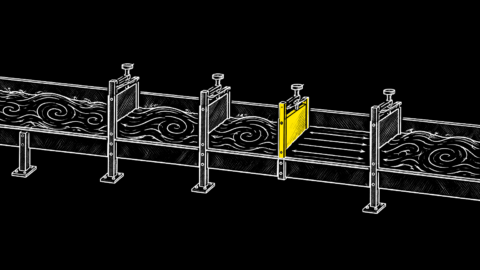
The team, led by group leader Florian Meinert at the university’s 5th Institute of Physics, held each atom in an optical tweezer, a tightly focused laser beam, between two glass plates 10.5 millimeters apart. The glass is coated with indium tin oxide, a transparent electrical conductor. The team used the plates to suppress the thermal microwave radiation that warm surroundings emit and that otherwise drives circular Rydberg atoms out of their states.
With the plates in place, the authors wrote, the atoms reached lifetimes that in free space would require surroundings cooled to 14 kelvin, about minus 259 degrees Celsius. The apparatus itself stayed at room temperature.
The team raised n from 79 to as high as 103, two levels at a time, with up to 12 microwave pulses. At n = 103, the electron’s orbit is about 1.1 micrometers across. Rydberg atoms stayed trapped in the tweezers with a lifetime of 133 milliseconds, a figure the authors described as a lower bound for the trapping time.
In a university press release on September 16, Meinert said the group had set three international records at once, for the longest lifetime measured for individual Rydberg atoms, the largest controlled circular Rydberg atoms, and the longest storage time for such atoms in optical tweezers. “We achieved these record results at room temperature without the costly liquid helium cooling previously required,” Meinert said. Tilman Pfau, head of the institute, said the team had “increased the stability of the atoms by a factor of 20.”
Lifetime and coherence
Nature Communications accepted the paper on September 3. The team had posted the results as a preprint on arXiv on October 31, 2025. The group also deposited the ion-arrival data behind the measurements on Zenodo, a public repository for research data.
The authors reported no new coherence measurement in the paper. For the 100-microsecond limit, they cited the group’s earlier work, including a 2024 paper in Physical Review X, and named noise in the magnetic field and nonuniform electric fields as the causes.
The authors wrote that, combined with recently demonstrated control of interactions between circular Rydberg atoms, their results could lead to “a novel Rydberg-based quantum simulator capable of boosting simulation times by orders of magnitude.” A quantum simulator is a controllable quantum system that researchers use to mimic another system whose behavior is hard to calculate.
A group at the Laboratoire Kastler Brossel in Paris described that interaction control in PRX Quantum in 2025. The Paris group measured the interaction between two individually trapped circular Rydberg atoms and tuned its strength by changing the orientation of an electric field.
Next steps
The authors wrote that the simulator they described also requires pushing the coherence time of qubits encoded in circular states into the millisecond range. They wrote that active feedback and careful cancellation of field gradients can improve coherence, and they named laser cooling and dynamical decoupling as further options.
In dynamical decoupling, researchers apply sequences of control pulses that cancel slow noise. The authors wrote that with these measures they expect coherence times on the scale of the circular-state lifetime to be within reach.
The paper’s authors are Einius Pultinevicius, Aaron Götzelmann, Fabian Thielemann, Christian Hölzl, and Meinert. Germany’s Federal Ministry of Research, Technology and Space funded the work through the CiRQus and QRydDemo grants. The EU also funded it through its Horizon Europe project EuRyQa.