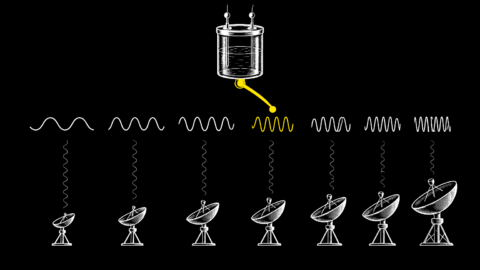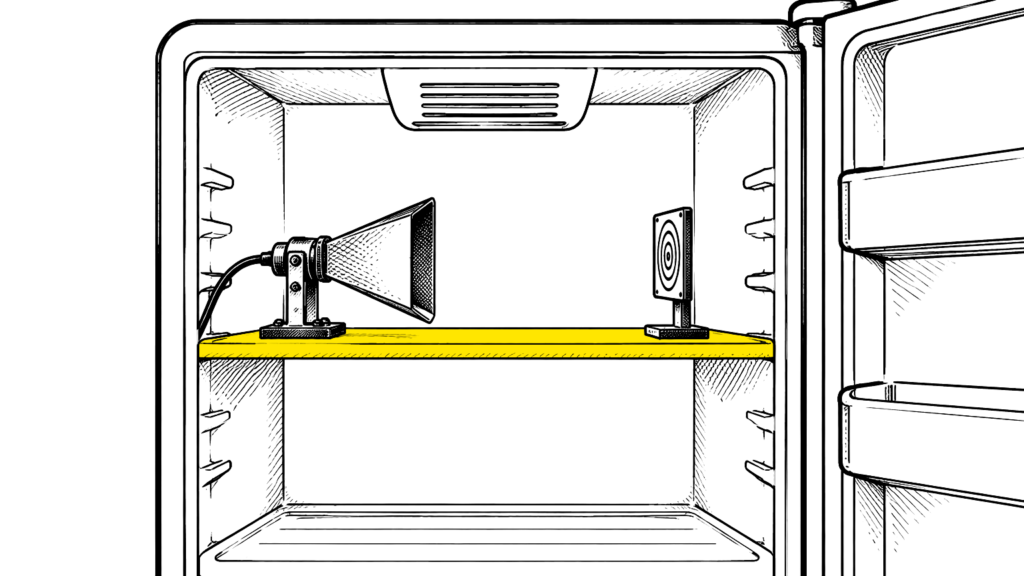
In the microwave quantum radar experiments reviewed below, researchers placed their targets about 1 meter away or inside a refrigerator. Chinese state media have reported detection at the 100-kilometer class for a single-photon quantum radar built by China Electronics Technology Group Corporation (CETC), a Chinese military electronics company.
Quantum illumination’s advantage over a classical radar of equal transmitted power has been measured only at lab distances, and the 100-kilometer detection claims made for China’s single-photon radar, a different technique, cite no published test. Researchers who have calculated the range of an entangled microwave radar put it between tens of meters and a few kilometers.
As of November 2026, defense planners have no published basis for counting quantum radar among counter-stealth sensors. Investors weighing a quantum radar proposal can ask the three questions that researchers have now answered with numbers: the range, the size of the target, and the classical radar used for comparison.
The theoretical advantage and its limits
Seth Lloyd of the Massachusetts Institute of Technology proposed quantum illumination in Science in September 2008. A transmitter sends one photon of an entangled pair toward a possible target and keeps its twin. The receiver then measures any returning light together with the stored twin to decide whether a target is there.
Lloyd predicted gains that grew with the amount of entanglement. Later in 2008, Si-Hui Tan, Jeffrey Shapiro of MIT, and six co-authors calculated the advantage for the Gaussian states that laboratories can actually produce. With the best joint measurement, they found “a 6 dB advantage in error probability exponent” over the best receiver for a transmitter of coherent states, the quantum description of a conventional radar signal.
The error-probability exponent is the rate at which a radar’s chance of wrongly deciding whether a target is there falls as the radar sends more modes. A mode is one slot of time and frequency in the transmitted signal. A 6-decibel gain in the exponent is a factor of four. A quantum transmitter could therefore reach a given confidence with about a quarter of the modes that a classical transmitter needs at the same energy per mode.
In a 2020 review, Shapiro wrote that the preferred operating regime for quantum illumination “has low signal brightness,” with a weakly reflecting target in a bright thermal background. He added that the bright-background condition “is not realistic for optical wavelengths.” Experimenters therefore turned to microwaves, the band that military radars use.
In 2020, Ranjith Nair and Mile Gu derived limits that apply to any transmitter with the same signal energy. Against bright thermal backgrounds, they found quantum illumination “nearly optimal” when it uses many copies of a weak entangled state called two-mode squeezed vacuum. In those conditions, then, another quantum design would have little room to do much better.
Shapiro also wrote that the advantage “degrades at constant pulse duration and bandwidth with increasing transmitter power.” Every receiver design he reviewed requires storing the retained photon, called the idler, for the full round trip. For two of the leading designs, he wrote, “6 dB of idler loss will eliminate QI’s performance advantage.”
A quantum illumination system, he added, “can only interrogate a single polarization-azimuth-elevation-range-Doppler resolution bin at a time.” In radar terms, it examines one small cell of direction, distance, and speed at a time. Shapiro concluded that the improvement is real but that “its value is severely limited.”
What the experiments measured
Shabir Barzanjeh, Johannes Fink, and two colleagues tested the idea against an object in open air. In Science Advances in May 2020, they reported generating entangled microwave fields in a refrigerator at about 7 millikelvin and using them to illuminate “a room-temperature object at a distance of 1 m.”
Their digital receiver beat what the authors called a “suboptimum” symmetric classical noise radar by up to 3 decibels at low signal photon numbers. A noise radar transmits random waveforms and correlates each echo with a stored copy. Against coherent states, the conventional radar signal, the authors wrote that their quantum illumination “cannot compete” in signal-to-noise ratio. They found an advantage over coherent states read by homodyne detection, a standard classical receiver, only after using their data to simulate an ideal photon counter on the idler.
In 2023, Réouven Assouly, Benjamin Huard, and three colleagues reported in Nature Physics “more than 20% better performance than any possible classical radar,” roughly 0.8 decibel, with an uncertainty of about 0.35 decibel. They measured the returning probe signal and the stored idler jointly. In the journal abstract, they wrote that they had measured the advantage “over a wide range of parameters” and that “the purity of the initial probe-idler entangled state is the main limiting factor.”
In the arXiv preprint of the same work, the authors wrote that earlier microwave experiments “have not demonstrated any quantum advantage as probe and idler were always measured independently.” They called their experiment “a proof-of-principle performed inside a dilution refrigerator.” In the preprint, they listed among the remaining difficulties “the limited range of parameters where a quantum advantage can be observed” and “the requirement for very low probe and idler temperatures.”
An 82-meter range reported in 2024 is a calculation. Patrizia Livreri of the University of Palermo and colleagues at INRiM, Italy’s national metrology institute, reported a “maximum range equal to 82.2 m” for a radar built around an entangled-photon source they had characterized. They obtained the figure from a radar range equation with an assumed target of 1 square meter, not from a detection. They described the work as “a modeling and a very preliminary characterization.”
Range calculations
Gabriele Pavan and Gaspare Galati of Tor Vergata University of Rome wrote a 2024 review in Remote Sensing for engineers and managers without quantum or radar training. They compared the quantum design with noise radar, its closest classical relative. They concluded that the maximum range of a quantum radar against typical aircraft is “intrinsically limited to less than one km,” and in most cases to tens of meters.
In their worked example, they assumed a radar at 9.37 gigahertz, with an antenna gain of 30 decibels and 1 gigahertz of bandwidth, and a target of 1 square meter at 1 kilometer. At room temperature, they calculated, the radar would have to integrate its signal for at least 346 hours, a result that “appears absurd.” With the target at 10 meters, the same radar would need about 10 milliseconds.
In Pavan and Galati’s example, moving the target from 1 kilometer to 10 meters raises the signal-to-noise ratio about 100 million times, because in the radar equation the echo’s power falls off with distance to the fourth power.
The two engineers traced the shortfall to the energy of a microwave photon. In a second example, based on a commercial marine radar at 9.4 gigahertz, they put that energy at 6.23 × 10⁻²⁴ joules. At 0.01 photons per mode, a level they called “optimal for quantum advantage,” they calculated that a microwave radar pulse carries 16 to 20 orders of magnitude less energy than detection requires.
They found a second penalty in the waveform of a quantum radar, a Gaussian noise signal with a peak-to-average power ratio of about 9 to 10. The peak-to-average ratio is a signal’s peak power divided by its mean. Pavan and Galati calculated that this ratio causes a loss close to 10 decibels in the matched filter, the receiver stage that compares each echo with a copy of the transmitted waveform.
A classical noise radar can shape its waveform digitally to a peak-to-average ratio as low as 1.5, a loss of 1.76 decibels. The authors wrote that this difference of about 7 to 8 decibels “largely compensates for the alleged maximum [quantum radar] advantage of 6 dB.” They added that a 6-decibel improvement “can be obtained, remaining in the conventional radar technology,” by enlarging the antenna. They put quantum radar’s costs at “five orders of magnitude greater than the equivalent conventional radar.”
Researchers at the German Aerospace Center (DLR) and the Technical University of Munich mapped where a quantum radar can beat a classical one. In IEEE Transactions on Radar Systems in 2024, Florian Bischeltsrieder, Wolfgang Utschick, and three colleagues put the “maximal feasible target distance” at about 300 meters. With higher-gain antennas, they wrote, the range might reach “at most 1 km,” but only for a target about 10 meters in size, a coincidence that “may be regarded as unlikely.”
The DLR and Munich researchers expected relevant uses “in the close-range regime with distances of several 10 m.” In a June 2025 follow-up, they wrote that an advantage is attainable only in “the extreme regimes of very low signal-to-noise ratios (SNRs) and high thermal noise levels,” with the hardware held at millikelvin temperatures.
In a June 2026 paper in AVS Quantum Science, Hossein Allahverdi and Ali Motazedifard reached a more favorable estimate. The two are quantum-technology researchers at the Iranian Center for Quantum Technologies and at two universities, the University of Tehran and Shahid Beheshti University. In their abstract, they concluded that with current technology an entangled noise radar could reach a maximum detection range of a few kilometers.
For the system in their Table II, they assumed an amplifier at 10 millikelvin and 0.05 signal photons per mode, with 200 milliseconds of detection time. They modeled a search mode, which tolerates a one-in-10 chance of a false alarm, and a track mode, which tolerates one in 1,000. For a target of 0.1 square meter, they calculated a maximum range of 1.56 kilometers in search mode, about 2.14 times the range of a comparable classical correlated noise radar, and 1.19 kilometers in track mode.
For a commercial drone of about 0.5 square meter, they calculated about 2.28 kilometers in search mode and 1.7 kilometers in track mode. For a light aircraft of about 10 square meters, they calculated 4.8 and 3.65 kilometers. They also wrote that “conventional antennas limit the potential benefits” of such radars.
Against a stealth aircraft, which they modeled as a target of about 0.0001 square meter, they calculated 271 meters in search mode and 206 meters in track mode. For an aircraft flying at 200 to 700 meters per second, they put the range needed for 60 seconds of warning at 12 to 42 kilometers, “which greatly exceeds the quantum-entangled radar’s maximum detection range.”
The most favorable of these estimates is 4.8 kilometers, for a light aircraft, from a calculation that no experiment has tested. The same aircraft at 100 kilometers would be about 21 times farther away and, by the fourth-power rule, would return about 190,000 times less echo power.
Where the long-range claims come from
Chinese state media attributed the 100-kilometer claim to CETC’s 14th Institute in September 2016. On September 8, the state news agency Xinhua reported that the institute’s Intelligent Perception Technology Laboratory had tested a quantum radar in mid-August, according to accounts by the Indo-Asian News Service and the Press Trust of India. The South China Morning Post, in a report that CNBC republished on September 21, wrote that CETC had announced the result in a statement on its website. Quantum Observer could not locate the Xinhua original or the CETC statement.
On September 12, Science and Technology Daily, the newspaper of China’s Ministry of Science and Technology, reported, citing CETC, that the 14th Institute had built what the newspaper called the country’s first quantum radar system based on single-photon detection. The newspaper wrote that the system reached detection at the 100-kilometer class in field tests in the real atmosphere. It named the University of Science and Technology of China (USTC), CETC’s 27th Institute, and Nanjing University as collaborators.
The newspaper described the radar as using quantum states to encode information and their higher-order correlations to suppress clutter, without giving a wavelength, transmitted power, target size, test date, or paper. It called the work groundwork for later microwave quantum radar and did not say that the tested system operated at microwave frequencies.
Popular Science reported CETC’s announcement on September 27, 2016, and explained that “a quantum radar instead uses entangled photons,” without mentioning single-photon detection. The magazine wrote that there is “a wide difference between a claim of a laboratory ‘proof of concept’ and the deployment of an actual working quantum radar.” It added that decoherence, the loss of quantum behavior through exposure to the environment, “imposes range limitations on current quantum radar prototypes.”
In August 2018, Science and Technology Daily reported, citing CETC, that the 14th Institute’s single-photon quantum radar had completed long-range detection tests. According to the newspaper, the team ran long-range tests on a plateau in northwestern China in 2015, after building a prototype, and later ran daytime long-range tests over the sea. It again reported detection at the 100-kilometer class in field tests in the real atmosphere, with no data and no paper.
Researchers at USTC reported in Optica in 2021 three-dimensional imaging at up to 201.5 kilometers with a single-photon lidar, using as few as 0.44 signal photons per pixel. A single-photon lidar pairs a pulsed laser with detectors that register individual photons. The USTC team thus showed that single-photon detection can work beyond 100 kilometers at optical wavelengths. Because the lidar needs no entanglement, its range is no evidence for or against entangled microwave radar.
In October 2025, the Chinese technology site IT Home reported, citing Science and Technology Daily, that the Anhui Province Quantum Information Engineering Technology Research Center had begun mass-producing a four-channel single-photon detector. According to the report, its developers had lowered the minimum operating temperature of the detector’s cooler from −50 to −120 degrees Celsius. In the version that Phoenix New Media reposted, the listed uses were single-photon radar and imaging, quantum communication, biofluorescence imaging, and deep-space laser ranging, with no detection range.
The South China Morning Post ran its English-language report under the headline “China mass producing next-gen quantum radar detector to track stealth aircraft like F-22.” The Post reported no detection range and no radar test either.
The 2016 and 2018 reports on CETC’s radar and the 2025 reports on the Anhui detector all concern single-photon detection, a different technique from the entangled illumination whose limits are set out above. No paper is cited in any of them. Readers can apply to such reports the paper-or-press-release test in Quantum Observer’s seven questions for judging a claimed quantum result.
The case for continued research
Shapiro, who set out several of the limits above, wrote that entanglement’s value on a channel that destroys entanglement “should spur continued research on quantum radar.” Researchers used the same idea to build floodlight quantum key distribution, a way of sharing encryption keys in which eavesdropping disturbs the signal. Shapiro wrote that it can deliver secret keys at gigabits per second over metropolitan-area fiber.
A second argument concerns ranging, the measurement of a detected target’s distance. Quntao Zhuang and Shapiro calculated in Physical Review Letters in 2022 that quantum illumination used for ranging offers “mean-squared range-delay accuracy that can be 10’s of dB better than a classical pulse-compression radar’s of the same pulse bandwidth and transmitted energy.” Their result is a calculation. The ranging scheme still requires keeping an idler pulse until the echo returns.
A third argument concerns short-range uses, from medical scanning to vital-sign monitoring. Barzanjeh’s team described the advantage at low signal power as “a promising feature for applications such as noninvasive biomedical scanning or low-power short-range radar.” Pavan and Galati wrote that their limits do not apply to very-short-range microwave uses such as tomography and the monitoring of heart and breathing activity.
The DLR and Munich team named medicine and cell biology as “a further application for low-power quantum radar.” Assouly’s group identified the purity of the entangled state as the main limit, an engineering problem that laboratories can work on.
These arguments support research at meters and in laboratories. None of them describes a route to detecting aircraft at tens of kilometers.
Quantum sensing beyond radar
The detectors of the Laser Interferometer Gravitational-Wave Observatory (LIGO) inject squeezed light into their interferometers. Squeezed light has its quantum noise reduced in one measurable property at the expense of another. The LIGO team reported in 2023 that frequency-dependent squeezing cut detector noise by 4.0 decibels at Hanford and 5.8 decibels at Livingston. The team put the resulting increase in the astrophysical detection rate at up to 65%.
Microwave quantum techniques have a measured success too, in the search for dark matter. Researchers in the HAYSTAC dark-matter experiment used a squeezed microwave field to “double the search rate for axions,” hypothetical dark-matter particles, between 4.100 and 4.178 gigahertz. Their dilution refrigerator had a base temperature of 61 millikelvin.
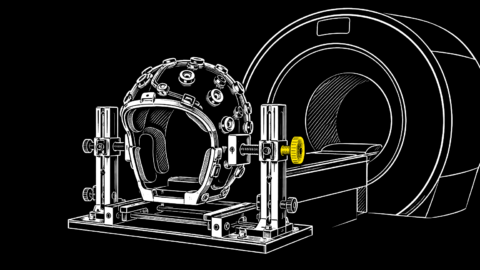
Elena Boto, Matthew Brookes, and colleagues reported in Nature in 2018 a magnetoencephalography scanner, which maps the brain’s magnetic fields, built on “the integration of quantum sensors” that “can be worn like a helmet, allowing free and natural movement during scanning.”
NATO scheduled sea trials of quantum sensors for positioning, navigation, and timing in 2026 and 2027, as Quantum Observer reported in its article on the alliance’s quantum roadmap. In a June 2026 trial, Aquark Technologies, the Royal Navy, Saab UK, and other partners synchronized two networked radars with Aquark’s cold-atom clocks, The Quantum Insider reported. The Defense Advanced Research Projects Agency (DARPA) pursued radio receivers built from Rydberg atoms, which have one electron raised to a very high energy level, in its completed Quantum Apertures program.
In each of these instruments, from LIGO’s detectors to the radar clocks and the Rydberg receivers, researchers prepare and read the quantum state inside the device. In quantum illumination, the radar must send its signal to a distant target and back through a warm, noisy channel, at power levels low enough to keep its advantage.
What would change this assessment
Researchers could overturn this reading of the evidence by publishing any of three results. The first would be a peer-reviewed experiment in which an entangled transmitter beats an optimized classical noise radar against a target hundreds of meters away, with transmitted power, target size, and integration time reported. The second would be published data from CETC’s field tests, including wavelength, transmitted power, and target size, for detection at the 100-kilometer class.
The third would be a protocol whose advantage grows with transmitted power, instead of degrading as Shapiro described. By the DLR and Munich team’s estimate, an experiment at about 300 meters would test the edge of the feasible regime. In the experiments reviewed here, researchers placed their targets no farther than about 1 meter away.