Researchers from Oak Ridge National Laboratory (ORNL), Cleveland Clinic, and IBM said on July 6, 2026, that they had used an IBM quantum processor in calculations of nine molecular configurations of FLiBe, a molten salt proposed for fusion reactors. In a release that IBM published, the organizations described the work as “the first-known instance of such computations on quantum computers.”
The 17 authors, from the three organizations and Michigan State University, posted the study on June 29 as a preprint, a paper not yet peer reviewed. They described molten salts such as FLiBe, a mixture of lithium fluoride and beryllium fluoride, as “leading blanket materials for breeding and recovering tritium in fusion reactors.” A blanket surrounds a fusion reactor’s plasma and breeds tritium, a radioactive form of hydrogen that the reactor uses as fuel.
Using the processor for the largest fragments, the team computed energy differences between nine arrangements of atoms to within 0.7 kcal/mol, or kilocalories per mole, of a fully classical version of the same fragmented calculation. Compared with unfragmented calculations, the fragmented ones differed by 12 kcal/mol on average for those energy differences and by 110 kcal/mol for tritium binding energies. The authors found that splitting the clusters into fragments, a classical step, introduced more error than solving the fragments did.
What ran on the quantum processor
The team drew two sets of nine snapshots of small FLiBe clusters from simulations of the molten salt’s atomic motion, one of pure FLiBe at 783.15 kelvins and one of clusters containing tritium at 900 kelvins. For conformational energy differences, the energy gaps between the snapshots’ atomic arrangements, it used 21-atom clusters. For tritium binding, it compared 22-atom negatively charged clusters with the same clusters bound to a tritium ion (T+).
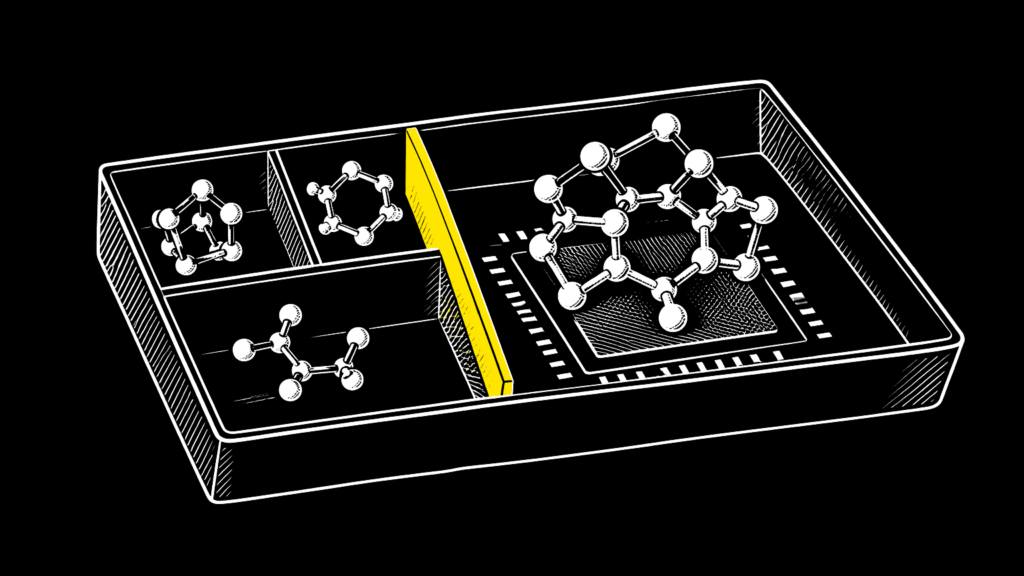
In embedding calculations, chemists divide a system into fragments and solve each one with a simplified model of its surroundings. The team divided each cluster into atom-centered fragments, each described by orbitals, the mathematical functions for where electrons can be found.
The team solved fragments with fewer than 13 orbitals using full configuration interaction (FCI), a classical method that gives exact results but becomes too costly for large systems. It sent fragments with 13 to 33 orbitals to ibm_boston, an IBM Heron r3 processor, at two qubits per orbital.
The team mapped the largest fragment, with 33 orbitals, onto a circuit of 66 physical qubits. In laying out that circuit on the chip, it also used extra physical qubits, called ancillas, beyond those 66 to mediate interactions between them.
For the fragments on the processor, the team used extended sample-based quantum diagonalization (ext-SQD). For each fragment, the team prepared a quantum state on the processor and measured it 100,000 to 1 million times, depending on the fragment’s size. Each measurement yielded a candidate arrangement of the fragment’s electrons.
The team then calculated each fragment’s lowest energy from those candidates on a classical computer. In the extended method, it added closely related arrangements before a final classical calculation. The team ran these classical steps on CPUs in high-performance computing systems at Michigan State University and the Cleveland Clinic Foundation, and the FCI calculations on Frontier, ORNL’s supercomputer.
Accuracy against the authors’ target
For the energy differences between the nine 21-atom clusters, the team measured a mean absolute deviation of 0.3 kcal/mol from the fully classical version. In absolute terms, the energies the team computed with the processor’s help were 2.1 to 2.9 kcal/mol above the classical values. The authors wrote that this offset was nearly constant across clusters, so it canceled in the energy differences.
For tritium binding energies, the team used a highly accurate truncated classical solver as the reference for the five largest fragments. Against that reference, it measured deviations of 0.7 kcal/mol on average and 0.9 kcal/mol at most.
The authors wrote that predictive free-energy simulations of tritium require accuracy of about kBT over simulation cells of more than 100 atoms. Chemists use free energy to predict which chemical states are favored at a given temperature.
The thermal energy kBT is Boltzmann’s constant times the temperature, the typical energy of random thermal motion. Near the blanket’s operating temperature of 900 kelvins, the authors put kBT at about 1.8 kcal/mol. At that scale, the quantum solver’s 0.7 kcal/mol error “shifts an equilibrium constant by less than a factor of 1.5,” they wrote.
A fragmentation error that reached 11–30 kcal/mol across the snapshots and changed sign “dominates any computed free energy,” the authors wrote. “The quantum solver is, therefore, already accurate enough,” they concluded.
Next steps
The authors wrote that the remaining task is to converge the embedding, meaning to refine the fragments until the results no longer change. They wrote that they will address it in future work and named chemically informed fragment construction, larger fragments, and more efficient quantum-classical solvers as key directions.
In a post on IBM’s quantum blog, IBM’s Rafi Letzter wrote that the plan is to grow the clusters “well past 21 ions” and to run “the hundreds of configurations the full binding free energy demands, not nine.”
Tom Beck, section head for science engagement in ORNL’s Computing and Computational Sciences Directorate, tied the work to the Department of Energy’s Genesis Mission. Beck said a team built to demonstrate the mission’s capabilities includes experts from “seven DOE national labs, four universities, three industry partners, and Cleveland Clinic.” He said it pursues “a multi-pronged discovery cycle aimed at optimizing tritium production in molten salt fusion blanket materials.”
Jerry Chow, IBM’s chief technology officer for quantum-centric supercomputing, said the results “add to mounting evidence that quantum-centric supercomputing is now a practical scientific tool.” IBM uses the term for systems that join quantum processors to classical supercomputers. In March, IBM researchers published a reference architecture for such systems.