Researchers from IBM, Rutgers University, and other institutions reported in Nature Physics on October 9, 2026, that they had controlled a chaotic process on a chain of up to 100 superconducting qubits by measuring and resetting individual qubits partway through a computation. Their largest circuits, run on ibm_fez, an IBM Heron r2 processor with 156 physical qubits, interleaved nearly 5,000 two-qubit gates with 5,000 mid-circuit measurement-and-reset operations.
The team showed that IBM’s hardware can run thousands of such operations in one circuit and still reproduce the predicted physics. It applied no error mitigation, the statistical techniques that reduce the effect of hardware noise on results, to its main measurements. The circuits encoded no logical qubits, the error-protected units that a fault-tolerant computer builds from many physical qubits, so the team did not test quantum error correction itself.
Bibek Pokharel of IBM and Haining Pan, a Rutgers postdoctoral researcher at the time of the study, were co-first authors. The authors wrote that co-author Barbara Jones, an IBM physicist, died during the preparation of the manuscript. The team first posted the work as a preprint in September 2025, and Nature Physics accepted it on August 26, 2026.
How the circuits worked
In each circuit, the team applied operations one at a time along the chain. Each operation was either a reset, chosen with probability p, or a random two-qubit gate that scrambled two neighboring qubits. A reset measured one qubit and flipped it back to zero if the result was one.
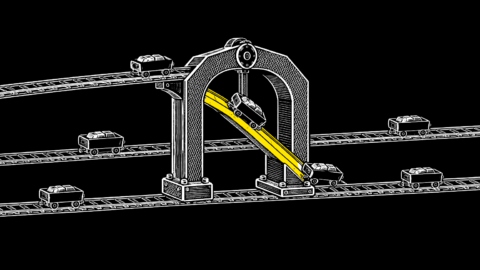
The team moved each new operation one site to the right after a scrambling gate and one site to the left after a reset. Without quantum effects, the model reduces to the Bernoulli map, a textbook chaotic system that doubles a number and keeps its fractional part, in competition with a control map that halves the number.
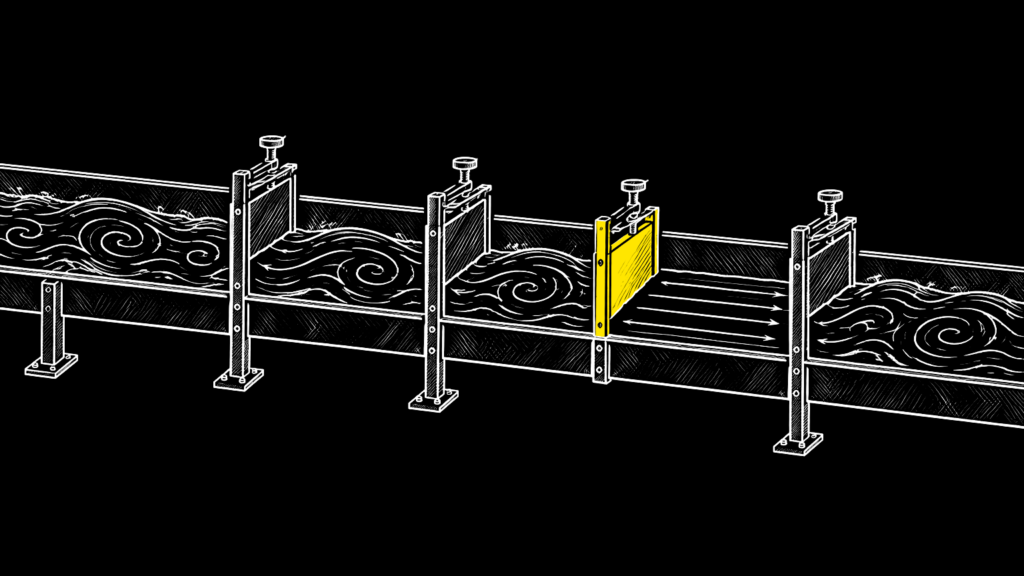
The team tracked the chain’s average magnetization, where a value near zero means the qubits read zero and one about equally often. When resets were rare, the scrambling gates kept the magnetization near zero. When resets were frequent, they drove the chain toward the state in which every qubit reads zero.
The team measured chains of 10 to 100 qubits to locate the model’s critical point, the reset probability at which a chain switches from the chaotic phase to the controlled one. It placed that point at p = 0.495, close to where resets and scrambling gates are equally likely. For the correlation-length exponent, a measure of how quickly the transition sharpens as chains get longer, the team measured 1.05.
The authors also simulated noiseless chains of up to 40 qubits with matrix product states (MPS), a classical method that stays efficient as long as entanglement remains limited. In those simulations, they found the same critical point and exponent within the quoted uncertainties. With a statistical-mechanics model of the circuits, run classically for chains of up to 100 qubits, they obtained a critical point of 0.497 and an exponent of 1.000.
Evidence of quantum behavior
Quantum measurement outcomes are random, so the magnetization varies from one run of a fixed circuit to the next. In the classical version of the model, a fixed circuit started from the same state always produces the same outcomes, so the variation disappears.
To test whether ordinary noise could produce similar variation, the authors compared the measured distributions with the noiseless simulation and with a classical model in which every qubit loses its quantum coherence after each gate. In the chaotic phase, the data were closer to the quantum simulation than to the noise model. In the controlled phase, none of the models matched the data. The authors attributed that mismatch chiefly to device noise, such as uncorrected readout errors.
The announcement and the experiment
Under the headline “Scientists Move a Step Toward Quantum Computers That Can Correct Their Own Mistakes,” Rutgers announced the paper on the day of publication. The university called real-time quantum feedback control “a capability considered essential for future quantum computers that will be fault-tolerant” and described the experiment as among the largest demonstrations of it to date.
“This experiment shows that present-day hardware can coordinate quantum operations, measurements and resets thousands of times across a large system,” said Maika Takita, IBM’s principal research scientist for quantum error correction and dynamic circuits experiments.
Jedediah Pixley, a Rutgers physics professor who directs the university’s Center for Materials Theory, said a fault-tolerant computer needs such checks and corrections “a huge number of times during a calculation.” “This experiment is a landmark on that road,” he said.
Each reset in the experiment measured a single physical qubit and returned it to zero. In quantum error correction, a processor instead measures error checks on groups of physical qubits in every cycle and sends the results to a decoder, a classical program that infers which errors occurred. The team used neither those group checks nor a decoder.
Rutgers said the IBM processor let the researchers go “far beyond the roughly two dozen” qubits they could simulate on conventional computers. In the paper, the authors simulated up to 40 qubits with MPS and computed averaged results for 100 qubits with the statistical-mechanics model.
IBM’s error-correction plans
For 2026, IBM plans to prototype its error-correction decoder and to demonstrate Kookaburra, a single module of its planned fault-tolerant computer that pairs a logical processing unit with quantum memory. IBM aims to deliver that computer, Starling, by 2029 with 200 logical qubits running 100 million quantum operations.
The Defense Advanced Research Projects Agency moved IBM into the final stage of its Quantum Benchmarking Initiative on October 7.