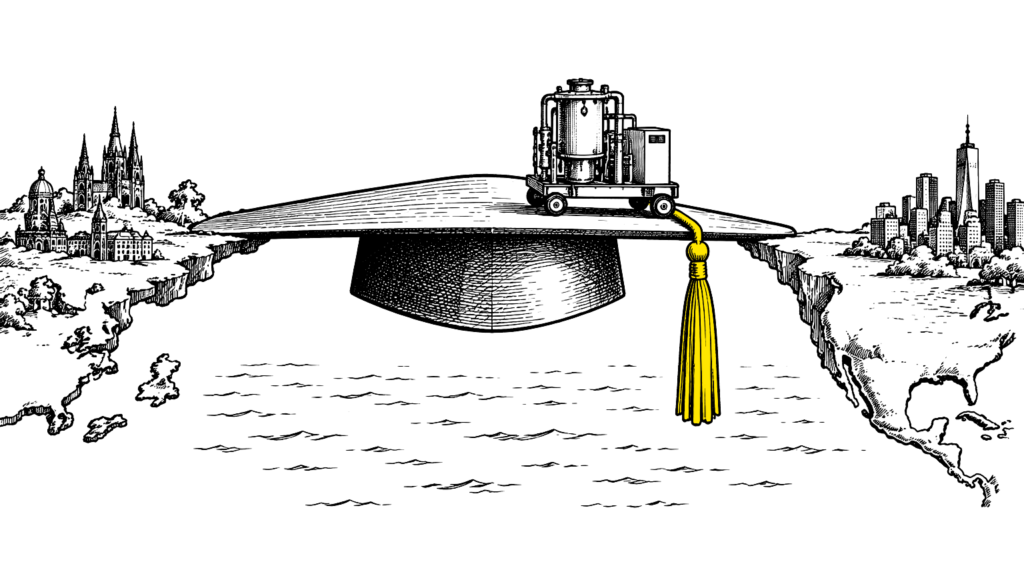
U.S. quantum computers depend on allied suppliers and foreign-trained scientists at several points where domestic substitutes are years from scale, so Washington, which frames quantum technology as a national race, has to secure allied supply as well as build factories at home.
In March 2026, the partners behind Q-PAC, a quantum computer in Colorado, said it was fully operational and called it “the nation’s first commercially deployable Quantum Open Architecture system.” Q-PAC has 17 physical qubits. In November 2025, the project’s partners said it would use a processor from QuantWare, a spin-out of the QuTech institute at TU Delft in the Netherlands. Its refrigeration came from Maybell Quantum of Denver, as Quantum Observer reported when the system opened.
In a survey of companies in 15 countries, released in September by six industry associations, 90% of respondents reported at least one supplier outside their home country. The inventions inside U.S. machines also came from several countries. The entangling gate on IonQ’s Aria-class systems, for example, was first proposed in a 1998 preprint from Aarhus University in Denmark.
The stronger claim, that every U.S. quantum computer runs on foreign parts, cannot be checked. Quantum Observer found no U.S. maker that publishes a full bill of materials. Some disclosed inputs are domestic. The Energy Department sells helium-3, the rare isotope that dilution refrigerators need, which is recovered during tritium processing at the Savannah River Site in South Carolina.
Where the ideas came from
Five inventions behind U.S. quantum computers came from laboratories in four countries, the United States, Japan, Denmark, and Russia. John Clarke, Michel Devoret, and Jay Gambetta did key work in the United States after earning their doctorates in Britain, France, and Australia.
| Invention | Where and by whom | Where it appears in U.S. machines | Sources |
|---|---|---|---|
| Quantum tunneling and energy levels in a superconducting circuit, 1984–85 | University of California, Berkeley. John Clarke, born in Cambridge, England, with a Cambridge PhD. Michel Devoret, born in Paris, with a doctorate from Université Paris-Sud, then a postdoctoral researcher. John Martinis, then a graduate student | The circuits were predecessors of today’s superconducting qubits | UC, Cambridge, Nobel Prize, Paris-Saclay, QB3 |
| Coherent control of a qubit in a superconducting circuit, 1999 | NEC Fundamental Research Laboratories, Tsukuba, Japan. Yasunobu Nakamura and Jaw-Shen Tsai of NEC, with Yuri Pashkin of CREST, Japan Science and Technology Corporation | Its device, the Cooper-pair box, is the design from which the transmon was derived | Nature, Koch et al. |
| Transmon qubit, 2007 | Yale University, with a co-author at the Université de Sherbrooke in Canada. Co-authors included Devoret and Jay Gambetta, who earned his PhD at Griffith University in Australia and now directs IBM Research | The physical qubits on the processor in Google’s 2024 below-threshold experiment | Koch et al., IBM, Google |
| Mølmer–Sørensen gate, 1998 preprint, published in 1999 | Aarhus University, Denmark. Klaus Mølmer and Anders Sørensen. IonQ’s documentation says several groups invented the gate simultaneously in 1999 | The native two-qubit gate on IonQ’s Aria-class systems. IonQ’s Forte systems use a ZZ gate | Mølmer and Sørensen, Physical Review Letters, IonQ |
| Toric code, 1997 | L.D. Landau Institute for Theoretical Physics, Moscow. Alexei Kitaev | Surface codes, which Kitaev introduced, are the codes in Google’s 2024 below-threshold experiment | Kitaev, Dennis et al., Nature |
In that 2024 experiment, published in Nature, Google researchers reported two surface-code memories operating below threshold, meaning that their physical error rates were low enough for a larger code to make fewer errors than a smaller one. Their processor used “a square grid of superconducting transmon qubits,” they wrote.
Two of the five inventions came from U.S. laboratories, with teams that included people born or trained abroad. Devoret now works at Google Quantum AI as well as Yale and UC Santa Barbara, and Gambetta directs IBM Research. U.S. companies employ some of the scientists who did that work.
No country can withhold a published paper, so the dependence that policy can affect is on foreign-trained people more than on published ideas. In Executive Order 14413, signed on June 22, President Trump directed the State and Commerce departments to promote research collaboration and the movement of people and ideas among like-minded countries.
Where the parts come from
Superconducting and silicon spin processors are typically cooled in dilution refrigerators to within a few thousandths of a degree of absolute zero. Bluefors of Helsinki said that the first unit of its KIDE refrigeration platform was ready for delivery to IBM in April 2023, and it credited its production facilities in Helsinki for the speed of the project.
Rigetti Computing, a builder of superconducting quantum computers, told investors in its annual report for 2025 that it buys “dilution refrigerators and associated helium gas products” from the cryogenic industry. It said it generally has multiple sources of supply but that “in some cases, materials are provided by a single supplier.” It also warned that political challenges between the United States and the countries where its suppliers are located “could adversely impact” its business.
Maybell is one U.S. maker of dilution refrigerators. Quantum Design of San Diego bought Oxford Instruments’ British refrigerator business in January 2026 and runs it as Quantum Design Oxford, from Oxfordshire, England. Quantum Observer has mapped the other makers and the export rules that cover them.
Makers of silicon spin qubits also depend on foreign supply of silicon-28 that has been purified of other isotopes. The Energy Department’s isotope office said in July that the United States had lacked scaled domestic stable-isotope enrichment since 1998.
Producers in South Africa and China have announced silicon-28 production. ASP Isotopes began commercial production in Pretoria in March 2025. In June 2026, China Daily, a state-owned newspaper, reported mass production by a China National Nuclear Corp. institute in Tianjin. Silex Systems finished building a plant in Sydney in June 2026 and expects sample production in the first quarter of 2027.
Processor fabrication is the most domestic of the major inputs for the largest U.S. companies. IBM said in November 2025 that primary fabrication of its quantum processor wafers is at the Albany NanoTech Complex in New York. IonQ bought SkyWater Technology, a U.S. contract chipmaker, in July 2026. Q-PAC’s partners, by contrast, planned to use a processor from a Dutch supplier.
A policy written for a race
In Executive Order 14413, Trump framed quantum technology as a contest. He described other nations moving quickly “to challenge American leadership,” and he set a policy that the United States “maintains a strategic technical advantage” in quantum information science and technology (QIST).
On supply, Trump looked first to domestic production and set several deadlines. He directed Commerce, in consultation with the Energy Department, to draw up a plan for the QIST sector that includes analyzing its supply chains, with a report due within 90 days. He gave the secretaries of War, Commerce, and Energy and the director of the National Science Foundation (NSF) 120 days to plan a partnership with the private sector, “potentially using prize challenges or advance market commitments,” to “develop quantum-enabling component technologies in the United States.”
He gave the secretary of War 180 days to “increase domestic access to Department of War-sponsored QIST-relevant foundry resources” and the NSF director the same period to take steps to issue grants for QIST user facilities. He gave his science adviser 210 days to task the National Quantum Initiative Advisory Committee with recommendations for “stimulating the development of quantum-enabling technologies in the United States.”
Trump also looked abroad. He directed the State and Commerce departments to align their international engagements to seek “strategic markets and capital from like-minded countries” for U.S. quantum companies and to keep trusted international supply chains, partly by “harmonizing investment restrictions with international allies and partners.” He called for harmonized research security and export controls to keep countries of concern from acquiring critical technologies. Reports on those directions are due within 180 days.
He gave the State Department 120 days to recommend how to align existing international engagements, “including Pax Silica,” with the order’s priorities. The State Department describes Pax Silica as its “flagship effort on Super Intelligence (SI) and supply chain security” with allies and trusted partners. Finland and the Netherlands, home to Bluefors and QuantWare, are among its signatories.
For domestic components, Trump named possible funding mechanisms, prize challenges and advance market commitments. For allied supply, he asked for alignment, reports, and recommendations.
The White House owes an updated National Quantum Strategy within 180 days of the order, by December 19, 2026. In that strategy, the administration could set out the balance between factories at home and suppliers abroad.
Federal programs already count on allies
Through its Quantum Benchmarking Initiative, the Defense Advanced Research Projects Agency (DARPA) is testing whether any approach to quantum computing can reach utility-scale operation by 2033. Of the 13 companies in Stages B and C as of October 8, six are headquartered abroad, according to DARPA’s listings. Diraq and Silicon Quantum Computing are based in Sydney, Quantum Motion in London, Xanadu in Toronto, Photonic in Vancouver, and Nord Quantique in Sherbrooke, Quebec.
Commerce has offered money under the CHIPS and Science Act to one of them. In May, it signed a letter of intent with Diraq for up to $38 million to develop silicon spin quantum logic units and scale manufacturing. DARPA moved Diraq into Stage C of its benchmarking initiative in October. Announcing the move, Diraq said it “has established its U.S. headquarters in Palo Alto,” with laboratories in Chicago and Albuquerque and a technology hub in Los Angeles.
The Energy Department (DOE) set a different rule for its Quantum Genesis Q Competition. Applicants must be for-profit entities formed in the United States with a U.S. place of business, according to the competition’s request for applications. All work must be done in the United States unless DOE grants a partial waiver.
DOE requires an explicit written waiver before a foreign entity can take part. An application led by a foreign entity must explain its corporate ties to the U.S. subsidiary or affiliate involved. DOE may also favor a majority U.S.-owned lead applicant.
Rigetti, D-Wave, and Quantinuum accepted conditions on where funded inventions are made when they signed their Commerce awards, according to their filings. Quantum Observer examines those conditions with the other award terms.
The three agencies have answered differently whether an allied company can take part in a national effort.
Allies set their own terms
Allied governments regulate what their companies sell abroad, including to the United States. Since November 15, 2025, the European Union has controlled exports of large dilution refrigerators, a category that includes the XLD1000sl, the highest-rated model that Bluefors lists.
In October, Europe’s quantum industry consortium, QuIC, told the European Commission that national authorities process the same EU control list “at different speeds” and interpret it “in different ways.” For start-ups and scale-ups, QuIC wrote, the result is “long and unpredictable lead times,” as Quantum Observer reported.
Washington already meets the governments of its main quantum suppliers in the Quantum Development Group. Its 13 members, the United States among them, agreed in April to treat “research security, investment security, and supply chain resilience” as one of three priority areas. The members include Finland, the Netherlands, Denmark, Japan, Australia, Canada, and the United Kingdom.
The case for building at home
Commerce has made the case for domestic capacity in its own words. Bill Frauenhofer, the department’s executive director of semiconductor investment and innovation, said in May that its quantum awards would provide “incentives to build domestic quantum capacity.” In the same notice, the department said it offers its CHIPS research incentives “to ensure continued United States leadership and national security.”
Supporters of that emphasis can point to allied suppliers that failed or slowed. M Squared Lasers, a Glasgow company that built laser systems for quantum research, entered administration, a British insolvency procedure, in August 2025. Some QuIC members reported losing customers to shipment delays under the EU’s export licensing.
U.S. companies and national laboratories are also adding domestic capacity. Commerce has awarded CHIPS money to Rigetti for a new cryostat architecture and to Quantinuum for photonics and optical components. IBM said in September that the first quantum wafers were running through the facility of Anderon, its quantum foundry subsidiary. Oak Ridge and Pacific Northwest national laboratories have produced silane, a silicon-bearing gas, with less than 1 part per million of silicon-29, the Energy Department said in July.
On this view, the United States needs allied suppliers only until a domestic supply chain is ready.
Schedules for domestic substitutes
On published schedules, U.S. companies plan their first fault-tolerant machines, which correct their own errors as they compute, before the September 2031 end dates of Commerce’s CHIPS agreements. IBM expects to deliver its first fault-tolerant system in 2029. DOE anticipates a final evaluation of first-generation fault-tolerant machines in September 2028. DARPA asks whether any approach can reach utility scale by 2033.
The Rigetti, D-Wave, and Quantinuum agreements end when the companies complete their milestones or on September 4, 2031, whichever comes first, according to their filings. D-Wave said its period can be extended. Quantum Observer sets out the milestone terms in its analysis of the awards.
The machines that U.S. companies plan to deliver before 2030 are therefore likely to depend on today’s suppliers, including allied ones, though no company has published a full bill of materials. If Washington secures only domestic production, those machines would remain exposed to allied licensing and supply decisions that it does not control.
What would change this assessment
Washington owes several decisions on these questions by early 2027. In the updated National Quantum Strategy, due December 19, the White House can say whether it counts allied suppliers as part of U.S. supply security or treats allies mainly as partners in export control. Reports on the order’s international directions, including trusted supply chains, are due the same day.
DOE planned to name its first Q Competition selections no earlier than November 13 and had named none by that date. A foreign entity among them will have needed a waiver. Commerce has yet to announce final awards for Atom Computing, Infleqtion, and Diraq.
Founded in Sydney, Diraq has set up a U.S. headquarters in Palo Alto. When Commerce finalizes Diraq’s award, the department will decide whether to attach domestic-production conditions, like those in the Rigetti, D-Wave, and Quantinuum agreements, to a company founded abroad.
This assessment would be overturned if U.S. makers began reporting domestic sources for refrigerators, enriched isotopes, and processors at volume before their first fault-tolerant machines. Allied restrictions on sales to U.S. buyers would do the opposite. They would raise the cost of the dependence described here and strengthen the case for domestic sources.