Elevate Quantum and five partner companies said on March 16, 2026, that Q-PAC, a quantum computer assembled from components made by several suppliers, was fully operational at the organization’s Commercialization Lab on the Quantum Commons campus in Colorado. The U.S. Department of Commerce designated the organization a regional technology hub under its Tech Hubs program.
The partners called Q-PAC “the nation’s first commercially deployable Quantum Open Architecture system.” In a quantum open architecture, a buyer assembles a quantum computer from parts made by different suppliers instead of buying one vendor’s integrated machine.
The partners reported the processor’s qubit count and an upgrade plan but released no gate error rates, coherence times, or benchmark results for it. Engineers use those measurements to judge how accurately a quantum computer carries out operations and how long its qubits retain information.
Disclosure: Quantum Observer’s Editor-in-Chief Marin Ivezic is the founder and CEO of Applied Quantum, a quantum systems integration and consulting firm.
What the partners built
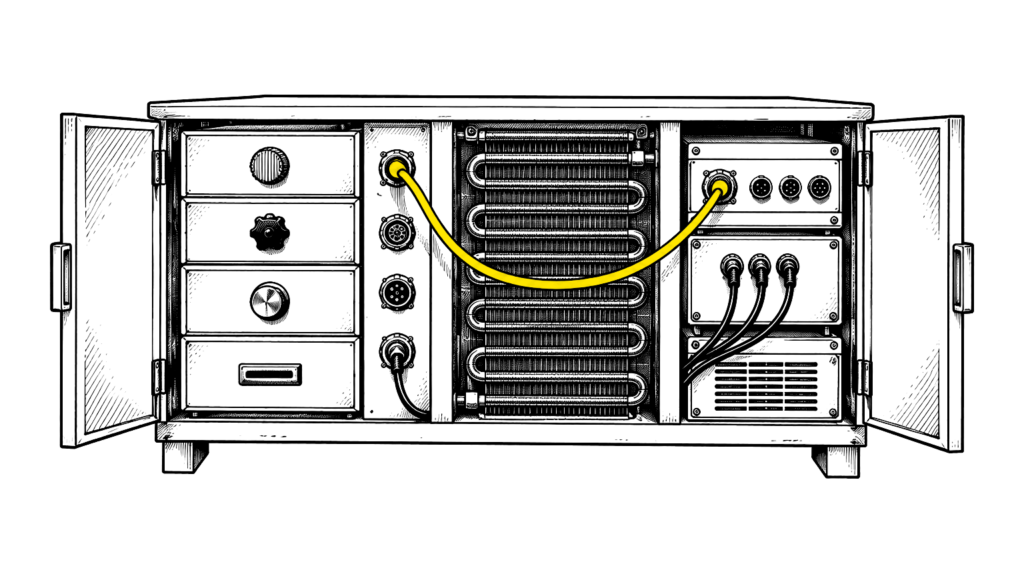
Q-PAC stands for Quantum Platform for the Advancement of Commercialization. According to the partners’ November and March announcements, they built it from a QuantWare processor, Qblox control electronics, Maybell Quantum cryogenic wiring and refrigeration, and Q-CTRL software.
Q-CTRL supplied Boulder Opal Scale-Up, which the partners described as AI-driven automation for calibration and control. It also supplied Fire Opal, for error suppression and circuit performance management.
Calibration is the routine tuning of the signals that drive each qubit. Error suppression is a family of methods for lowering the error rate of each run without the extra qubits that error correction requires.
The partners based the system on the Quantum Utility Block, a family of pre-validated reference designs that QuantWare, Qblox, and Q-CTRL launched on November 17, 2025. A reference design is a blueprint of a system’s components and the connections between them. Those companies offered the designs in Small, Medium, and Large configurations of 5, 17, and 41 qubits.
In March, the partners said Q-PAC’s initial processor has 17 qubits. They said the same platform will support 100-qubit-class chips heading into 2027 without replacing infrastructure. Each of these figures is a count of physical qubits, the hardware qubits on a chip. An error-corrected logical qubit is built from many physical qubits.
Status and site
In the March release, the partners said the system gives users “integrated access to a complete quantum computing stack,” from processors and control electronics to cryogenics and calibration software.
Jessi Olson, the hub’s chief operating officer and chief financial officer, described Q-PAC in the release as “a fully reproducible, commercial-grade quantum system where companies can test-drive their quantum future before they build their own.”
The Quantum Commons is a 70-acre campus in Arvada, a suburb of Denver, on property owned by the Colorado School of Mines. Mines and its partners broke ground there in September 2024.
From announcement to operation
The partners first announced Q-PAC on November 17, 2025, with Maybell Quantum, Q-CTRL, QuantWare, and Qblox named as partners. In that announcement, they said users would have both cloud and on-premises access. They also said QuantWare would supply the processor.
In March, the partners said the system had “advanced from concept to full operation in just five months.” They also said they built it “at a fraction of the cost compared to closed, full-stack systems,” without giving prices. The March release listed Arrow Electronics as a fifth partner.
What comes next
Through Arrow, the partners said, the Quantum Utility Block framework will include a reference server built around a GPU cluster and linked to the quantum hardware through NVIDIA’s NVQLink. They said the server would provide ultra-low-latency computing without the need for FPGA programming. FPGAs, or field-programmable gate arrays, are reconfigurable chips that quantum control systems often use for fast feedback.
NVIDIA introduced NVQLink in October 2025 as an open system architecture for coupling GPU computing with quantum processors.
The partners did not give a date for the GPU server. The only next step for which they gave a time frame is the processor upgrade heading into 2027.