In a Federal Register notice published October 27, 2026, the United States Department of Energy added helium to its Critical Material List and named quantum computing among the energy functions for which it said helium cannot be substituted. In the notice, the department did not mention helium-3, the rare isotope that dilution refrigerators need to cool superconducting and silicon spin qubits. The department obtains its helium-3 from a single source, the tritium operations of the National Nuclear Security Administration.
Funding programs often sort quantum computers by modality, the physical system a machine uses as its qubits. The UK’s National Quantum Computing Centre (NQCC) reported in October that it had exceeded its target of “at least three distinct modalities,” with five in its testbed program. Sorted instead by what each machine depends on, from cold and light to vacuum, wafer fabrication, purified materials and classical computing, the same industry looks different.
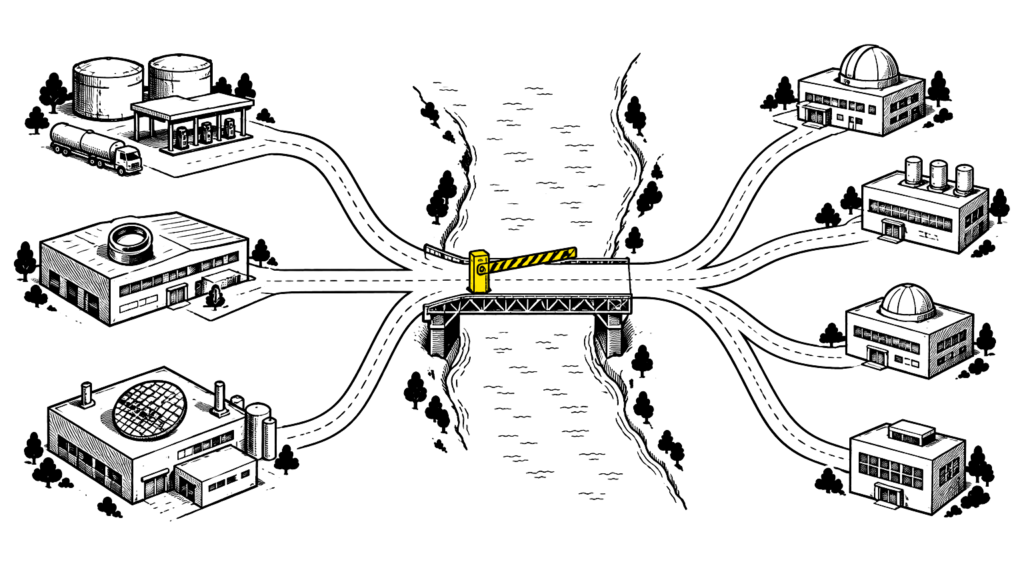
Rival platforms share a short list of chokepoints, so a portfolio or national program that spreads its money across qubit types can hold the same supply risk two or three times. Since 2024, the United States has controlled exports of several of those inputs directly, starting with the large dilution refrigerators that superconducting and spin-qubit machines need. The European Union followed in 2025.
Cold
A dilution refrigerator cools its contents to within a few thousandths of a degree of absolute zero by circulating a mixture of helium-3 and helium-4. IBM’s engineers built the cryogenic cells for its future machines on established dilution refrigerator technology. Diraq and imec researchers measured their silicon spin qubits in a Bluefors refrigerator at a base temperature of 10 millikelvin.
Bluefors, based in Helsinki, said in 2022 that it had installed its 1,000th system. Rob Meyerson, chief executive of the helium-3 company Interlune, said in 2025 that “a majority of the quantum technology industry relies on Bluefors systems.” Other makers include Maybell Quantum, whose refrigerator houses the processors in TreQ’s open-architecture testbed in Oxfordshire.
Oxford Instruments agreed in June 2025 to sell its NanoScience business, a maker of dilution refrigerators, to Quantum Design of San Diego for £60 million. Quantum Design announced the completed purchase in January 2026 and renamed the business Quantum Design Oxford. In China, state media reported in February 2024 that the Anhui Quantum Computing Engineering Research Center and QuantumCTek had begun mass production of a domestically developed dilution refrigerator that reaches 10 millikelvin.
Bluefors also owns part of its own supply chain. In 2023 it completed its purchase of Cryomech, a Syracuse, New York, maker of pulse-tube cryocoolers.
Since September 2024, the United States has required licenses to export the largest of these refrigerators. The Commerce Department’s Bureau of Industry and Security (BIS) controls cryogenic systems “rated to provide a cooling power greater than or equal to 600 µW at or below a temperature of 0.1 K” for more than 48 hours, along with two-stage pulse-tube cryocoolers above set ratings. Bluefors rates its XLD1000sl, the highest-rated model in its comparison table, above 1,000 microwatts at 100 millikelvin, over that line. The European Union added both items to its control list in a regulation that took effect on November 15, 2025.
BIS lets exporters skip the license for a few countries that apply equivalent controls, under License Exception IEC. In its table of eligible destinations, BIS listed Germany, Italy and the United Kingdom for these refrigerators in September 2024 and added Finland, Norway and the Netherlands by December of that year.
Helium-3
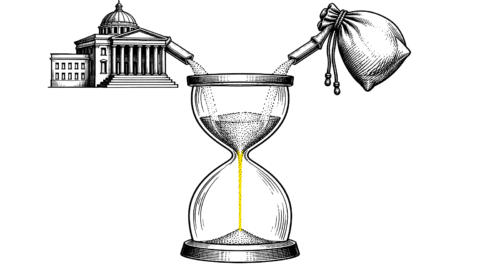
Interlune said in July 2026 that most helium-3 comes from “aging tritium stockpiles” and that “those stockpiles are limited.” Tritium is a radioactive form of hydrogen that decays into helium-3. The Energy Department’s Isotope Program sells helium-3 that the National Nuclear Security Administration recovers during tritium processing at the Savannah River Site in South Carolina. The program also chairs a White House inter-agency group that “establishes priorities for federal He-3 utilization and allocations of existing inventory.”
The United States has run short of helium-3 before. After 2001, the U.S. stockpile was drawn down from about 235,000 liters to about 50,000 liters by 2010 to supply neutron detectors at border crossings, against production of about 8,000 liters a year, the Congressional Research Service reported. On a page about helium-3 supply and demand, the Energy Department says that “demand as high as 70,000 liters per year was outpacing government supply in 2008.” It credits recycling and alternative technologies with cutting projected federal demand below 6,000 liters a year and does not mention quantum computing on the page.
Laurentis Energy Partners, a subsidiary of Ontario Power Generation, said in 2021 that it would extract helium-3 from tritium stored at the Darlington nuclear station. Air Liquide announced a long-term partnership with Laurentis that December to secure that supply.
Interlune has agreed to sell Bluefors up to 10,000 liters of helium-3 a year from 2028 through 2037, from helium-3 it plans to collect on the Moon. In July 2026, the company said it had produced 99% pure helium-3 from Grade A helium on Earth by cryogenic distillation. It estimated that the method could roughly triple U.S. domestic production if deployed across helium plants. It also reported nearly $500 million in binding purchase agreements, mainly with Bluefors and Maybell.
Adiabatic demagnetization refrigerators reach millikelvin temperatures with magnets instead of helium-3. In an abstract for the American Physical Society’s March 2026 meeting, Jan Spallek of kiutra, a maker of magnetic refrigerators, described continuous operation of such a system. He wrote that “most millikelvin systems rely on helium-3–based dilution refrigeration, creating scalability challenges.”
Cryogenics beyond superconducting machines
Photonic machines depend on cryogenics too. PsiQuantum said in February 2025 that its chips use a superconducting material to detect single photons. It also said it was “eliminating the iconic ‘chandelier’ dilution refrigerator in favor of a simpler, more powerful, and more manufacturable cuboid design.” For its NQCC testbed, ORCA Computing had to “integrate cryogenics into the platform for the first time,” the center reported.
Light
Trapped-ion and neutral-atom machines do much of their work with lasers. Toptica, a maker of lasers for quantum research, says a trapped-ion system typically needs 6 to 10 different types of lasers and a neutral-atom system up to a dozen. Some must be stabilized “to a linewidth on the order of one Hz,” the company says.
Quantinuum picked the atoms for its newest computer partly because of the lasers they need. The company switched the qubits in its Helios computer from ytterbium to barium, which it said “can be manipulated with lasers in the visible part of the spectrum.” Its earlier ytterbium systems largely relied on ultraviolet lasers that the company called “expensive and hard on other components.”
M Squared Lasers, a Glasgow company that built laser systems for quantum research, entered administration on August 27, 2025, after its board said it lacked the cash to meet its obligations. The administrators said 28 employees were laid off when the company stopped operating. Novacene Photonics, led by former M Squared executives, bought its intellectual property and other assets in November.
Toptica offers the same categories of laser products for both modalities. An investor with stakes in trapped-ion and neutral-atom companies can be exposed twice to the same laser suppliers.
Vacuum
Ions and neutral atoms are held in ultra-high vacuum, where collisions with stray gas molecules limit how long they stay trapped. Trapped-ion and neutral-atom designs do not need dilution refrigerators, but some groups now cool their traps to improve the vacuum, among them University of Maryland researchers with a 4-kelvin cryostat. Groups that cool their traps this way add cryogenic equipment to the inputs their platform needs.
Wafer fabrication
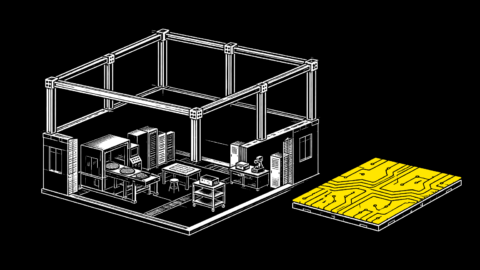
Superconducting, silicon spin and photonic processors are made on semiconductor wafers, and so are the ion traps of Oxford Ionics. Since 2025, the largest quantum companies have been buying or building that capacity.
IBM moved its processor wafer fabrication to a 300-millimeter facility at the Albany NanoTech Complex in New York. The company said in November 2025 that it had doubled the speed of its research and development after the move.
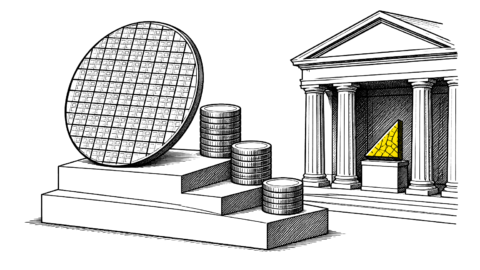
In September 2026, Commerce finalized a CHIPS award of up to $1 billion to Anderon, a new IBM subsidiary that plans to run a quantum wafer foundry for outside customers. IBM said that the first quantum wafers were running through Anderon’s facility. On October 14, Anderon released its first process design kit for superconducting chips, the design rules and component models that outside designers work from, but named no customer.
PsiQuantum said in February 2025 that its chips are manufactured at GlobalFoundries in New York. Mark Thompson, a co-founder and then PsiQuantum’s chief technologist, said the company’s technology is made “in a high-volume semiconductor fab that normally produces chips for cell phones and laptops.” Commerce finalized a separate award of up to $375 million to GlobalFoundries for quantum foundry research and took an equity stake in the chipmaker.
IonQ completed its purchase of Oxford Ionics, whose traps are made with standard semiconductor chips, in September 2025. It then completed its purchase of SkyWater Technology, a U.S. contract chipmaker, in July 2026. SkyWater’s chief executive, Thomas Sonderman, said in IonQ’s release that SkyWater remained “fully committed” to all of its semiconductor foundry customers. IBM also closed its acquisition of HRL Laboratories, a research laboratory whose work includes silicon spin qubits, in August 2026.
Silicon spin-qubit makers use the same 300-millimeter plants that make conventional chips. Intel released Tunnel Falls, a chip with 12 physical qubits made on 300-millimeter wafers, in 2023.
Soitec, STMicroelectronics and Quobly said in December 2025 that wafers built on Soitec’s silicon-28 substrates were running through ST’s 300-millimeter plant in Crolles, France. They expected the earliest performance metrics from those prototype devices in the first quarter of 2026. Quantum Observer found none published by November 12, 2026.
European companies are adding fabs built only for quantum chips. QuantWare said in May that it was building KiloFab, “the world’s largest dedicated quantum open architecture fab.” The Novo Nordisk Foundation plans a 5,300-square-meter quantum chip plant in Copenhagen, expected to open in 2027.
In its Chips Act 2.0 proposal, the European Commission keeps six quantum chip pilot lines but lists no quantum area among its priorities for strategic projects. Europe’s quantum industry consortium, QuIC, asked in September for one to be added.
A company that owns a fab, as IonQ now owns SkyWater, controls its own lead times and decides how much capacity outsiders get.
Purified materials
Silicon spin qubits need silicon stripped of silicon-29, an isotope whose nuclear spin disturbs nearby qubits. Natural silicon is about 4.7% silicon-29, according to the Commission on Isotopic Abundances and Atomic Weights. Diraq and imec researchers reported in Nature in 2025 that residual isotopes carrying nuclear spin were a major source of operational errors in their devices. Their devices used silicon with 400 parts per million of silicon-29 remaining.
Silex Systems, an Australian company commissioning a laser-enrichment plant, puts the useful ceiling for quantum computing at 500 parts per million of silicon-29. It estimates the current market at less than 50 kilograms a year.
Four producers advanced between March 2025 and July 2026, at very different stages. ASP Isotopes began commercial production of enriched silicon-28 at its second enrichment facility in Pretoria, South Africa, in March 2025 and said it had supply agreements with two U.S. customers. In June 2026, China Daily reported that a Tianjin institute of China National Nuclear Corp. had mass-produced silicon-28 with an isotopic abundance above 99.99%.
Silex completed construction of its Sydney plant in June 2026 and is commissioning it. It expects sample production in the first quarter of 2027 and initial capacity of up to 20 kilograms a year. In July, the Energy Department’s isotope office said that Oak Ridge and Pacific Northwest national laboratories had produced silane, a silicon-bearing gas, with silicon-29 below 1 part per million. The office said the United States had lacked scaled domestic stable-isotope enrichment since its wartime calutrons, electromagnetic isotope separators, were decommissioned in 1998.
Trapped-ion machines also work with a single isotope of a particular element. Makers can select that isotope while loading atoms from a natural mixture, and some buy enriched material instead. In September 2025, ASP Isotopes announced an order for enriched barium-137 from a U.S. customer and said high-purity barium-137 is “emerging as a critical enabler of ion-trap quantum computing.” The Energy Department lists ytterbium-171, “used for trapped-ion quantum computing,” among the isotopes its Oak Ridge separators can produce.
BIS has controlled exports of the purest silicon since September 2024. It controls silicon “having an isotopic impurity less than 0.08% of silicon isotopes other than silicon-28 or silicon-30,” along with comparably enriched germanium. That threshold equals 800 parts per million. The control therefore applies to every grade that Silex describes as useful for quantum computing.
The European Union set the same 0.08% threshold for silicon and germanium in its 2025 regulation. In BIS’s table for License Exception IEC, Italy and the United Kingdom could receive enriched silicon without a license in September 2024, and BIS added Finland, Norway and the Netherlands by December of that year.
Classical computing
Every error-corrected machine needs a decoder, a conventional processor that reads its error checks and works out the corrections. IonQ researchers wrote that a decoder must keep pace “to avoid a decoding backlog that can induce an exponential slowdown of the quantum computation.”
Decoder builders use mainstream chips from AMD, Altera and NVIDIA. Riverlane validated its decoder interface on Altera FPGAs, a kind of reconfigurable chip, and measured its physical layer on AMD’s. Quantinuum plans real-time decoding on NVIDIA Grace Hopper GPUs. In a preprint, Xanadu researchers timed a round trip between an AMD FPGA board and an AMD processor at a median 2.305 microseconds, without a quantum processor attached.
Some electronics built to work beside the qubits are export-controlled. BIS controls CMOS chips designed to operate at or below 4.5 kelvin and parametric signal amplifiers that operate at very low temperatures. The European Commission added cryogenic electronic components and parametric signal amplifiers to the EU list in 2025.
Where the dependencies cross
| Input | Platforms that depend on it | Supply, November 2026 | Source |
|---|---|---|---|
| Helium-3 | Superconducting, silicon spin | Mostly from tritium stockpiles. Interlune’s Earth and lunar sources are not yet delivering. | Interlune |
| Dilution refrigerators | Superconducting, silicon spin | A few makers, Bluefors the largest by its partner’s account. Large units are export-controlled in the U.S. and EU. | Bluefors, Federal Register, EU regulation |
| Other cryostats | Photonic detectors, some ion and atom traps | Cryostats for detectors and traps. Pulse-tube cryocoolers above set ratings are export-controlled in the U.S. and EU. | Pagano et al., Federal Register, EU regulation |
| Precision lasers | Trapped-ion, neutral-atom | 6 to 12 laser types per machine from shared suppliers. One UK maker failed in 2025. | Toptica, Interpath |
| Ultra-high vacuum | Trapped-ion, neutral-atom | Vacuum limits trap lifetimes. Groups that add cryostats also depend on cryogenic suppliers. | Preprint, Pagano et al. |
| Wafer fabrication | Superconducting, silicon spin, photonic, ion traps | Leaders own or fund fabs. CHIPS foundry awards went to Anderon and GlobalFoundries. | NIST (Anderon), NIST (GlobalFoundries) |
| Enriched isotopes | Silicon spin, trapped-ion | Silicon-28 from one new commercial producer and one reported in China, with a plant commissioning and a U.S. laboratory process. The purest silicon and germanium are export-controlled in the U.S. and EU. | ASP Isotopes, China Daily, Silex, DOE, EU regulation |
| Real-time decoders | Every error-corrected design | FPGAs, GPUs and CPUs from AMD, Altera and NVIDIA | Xanadu preprint, Altera, Quantinuum |
Two pairs of rival platforms share most of their inputs. Superconducting and silicon spin machines both need helium-3 and dilution refrigerators. Trapped-ion and neutral-atom machines both need precision lasers and ultra-high vacuum. Every error-corrected design needs a decoder built from the same few chip families.
The case for sorting by modality
The strongest case for the usual view is that technology risk still outweighs supply risk. Micah Stoutimore, managing director of DARPA’s Quantum Benchmarking Initiative, said in October that DARPA did not yet know which teams or technical approaches would reach a utility-scale machine. While that question is open, spreading money across modalities is a reasonable hedge against backing the wrong one.
The silicon-28 market of 2025 and 2026 is the best evidence for that view. Within 16 months, four producers advanced, from commercial production in South Africa to national-laboratory output in the United States, in a market that Silex puts below 50 kilograms a year. When volumes are that small, new suppliers can appear soon after buyers do.
Helium-3 supply does not follow that pattern. It depends on tritium that governments keep for nuclear weapons and that utilities produce in heavy-water reactors, according to the Congressional Research Service. Interlune’s first scheduled lunar deliveries to Bluefors begin in 2028.
Governments have added a second constraint, one that funders cannot hedge by spreading money across modalities. U.S. and EU regulators define each controlled item by its technical ratings, such as cooling power or isotopic purity. An exporter therefore needs the same license for a large dilution refrigerator whether it will cool a superconducting chip or a spin-qubit chip. QuIC said in October that some members had lost customers to shipment delays under the EU’s licensing system.
Sovereignty, input by input
Six industry associations reported in September 2026 that 90% of responding quantum companies had at least one supplier abroad. China ranked sixth among supplier locations, although Chinese companies were not invited to take part. Chinese state media have reported domestic production of two inputs on this list, dilution refrigerators and silicon-28.
The European Commission provisionally listed its Quantum Act for November 24 in a planning document dated November 10, after an earlier list had it on November 18. Under a draft obtained by The Quantum Insider, strategic projects and public procurement would generally be reserved for EU-controlled suppliers, with a route for qualifying partners. The draft lists quantum foundries, chip fabrication and packaging as priority areas. In the United States, Commerce has paired its CHIPS quantum awards with equity stakes in D-Wave, Rigetti, Quantinuum and GlobalFoundries.
A government’s claim to sovereign quantum capability can be tested input by input, by asking who makes its refrigerators, who supplies its helium-3, who owns its fabs, who enriches its silicon and who sells it decoder chips. A country can fund processor development without controlling any of them.
What would change the picture
Five developments would change this map. Each will appear first in a company announcement or a government notice.
- Silex’s first silicon-28 samples, due in the first quarter of 2027, and device results from the new silicon-28 sources on production wafers.
- Interlune’s first helium-3 deliveries to Bluefors, scheduled from 2028, and the first helium plant to adopt its Earth-based method.
- The number of dilution refrigerators per processor as IBM fills its joined cryogenic cells. By 2027, IBM plans to link multiple processors into a computer with at least 1,000 programmable qubits, those that can be used directly in computations.
- Named outside customers for Anderon and for GlobalFoundries’ quantum business.
- The European Commission’s Quantum Act proposal and its evaluation of the EU’s dual-use export regulation, due by September 2028.
The input view would matter less if one modality pulled clearly ahead. Funders and governments could then concentrate on the leading modality’s inputs.