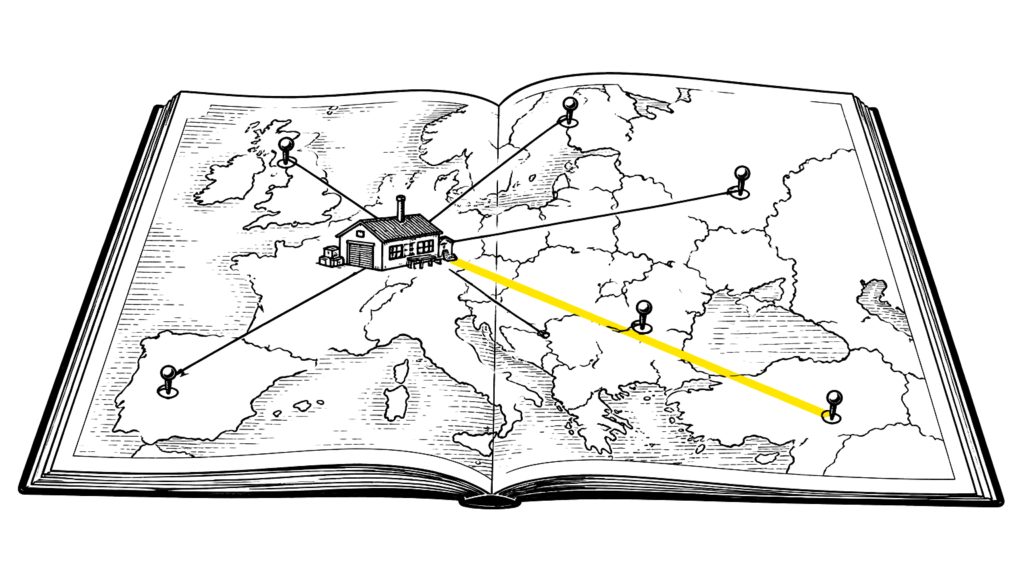
Ninety percent of responding quantum companies in a survey by six industry associations reported at least one supplier outside their home country, and 74% named one or more foreign customers. The associations released the findings in Global Quantum Supply Chain Flows 2026 on September 23, 2026, the opening day of Quantum World Congress in College Park, Maryland.
The Quantum Economic Development Consortium (QED-C) in the United States published the report with the European Quantum Industry Consortium (QuIC), Quantum Industry Canada (QIC), UKQuantum, Japan’s Quantum Strategic Industry Alliance for Revolution (Q-STAR), and the Korea Quantum Industry Association (KQIA). In their announcement, the associations said they intended the study to give “policymakers and investors a clearer view of the cross-border relationships” in the quantum economy.
Respondents named the countries where they buy, sell, and manufacture, but they did not report what they buy, in what volumes, or from how many suppliers in each country.
The associations also wrote that “most quantum companies rely on foreign suppliers.” Respondents were asked to leave out widely available off-the-shelf parts that are easy to substitute.
Supplier and customer countries
The 160 companies are headquartered in 15 countries. Together they named suppliers in 36 countries, customers in 49, and manufacturing sites in 25. The median respondent named three countries each for suppliers and customers and one for manufacturing.
Respondents most often named their own country, the report’s authors wrote. The United States led both the supplier and customer rankings, with Germany, the United Kingdom, Canada, and Japan completing the top five in each. Counted as a bloc, the European Union ranked second only to the United States in both.
China ranked sixth among supplier locations, named by 37 respondents based in 10 countries, according to the report. Nine respondents named it as a customer location and three as a manufacturing location. Chinese organizations were not invited to take part, so China appears in the results only as a location that other companies named.
The 35 respondents that described themselves only as component suppliers reported selling into more countries than the 36 that described themselves only as systems developers. The authors attributed the difference to the two groups’ “different commercial maturity.” They wrote that component makers already have an established customer base and that complete systems remain largely pre-commercial.
Most companies manufacture only in their home country, the authors wrote. Of the 116 respondents that answered the manufacturing question, 45 named the United States as a manufacturing location. Twenty-nine respondents named Canada and 21 the United Kingdom.
How the survey was run
The associations surveyed their members in March and April 2026. Companies in India also took part, with Abhishek Purohit, director of technology strategy at QURECA, serving as the study’s liaison there.
Qualifying companies buy or sell quantum components or systems, provide fabrication or testing services, or offer quantum-system access as a service. Research organizations were excluded from the sample. The associations estimated that the 160 respondents make up about two-thirds of their eligible members.
Of the 160, 146 answered the question on suppliers, 133 the one on customers, and 116 the one on manufacturing. The largest groups of respondents were headquartered in the United States (37), Canada (34), the European Union (25), and South Korea (25).
Quantum Australia, the national industry consortium, was unable to take part, so that country also appears only as a location that other companies named. The authors wrote that they kept the survey nonproprietary to get as many responses as possible.
What the associations said
The authors wrote that companies benefit from policies that “allow access to markets and preferred suppliers based in like-minded countries.” Controls on trade “should protect flow of critical technologies” without hampering innovation and growth, they wrote.
“Quantum innovation does not stop at national borders, and neither do the supply chains that make it possible,” Celia Merzbacher, executive director of QED-C, said in the announcement. She said the International Council of Quantum Industry Associations (ICQIA), to which all six publishers belong, “can use this shared evidence to strengthen international coordination.”
Cécile Perrault, executive director of QuIC, said “the countries this industry buys from and the countries it sells to are not always the same.” She said Europe should keep that in mind as it shapes its industrial and trade policy for quantum.
Jonathan Legh-Smith, executive director of UKQuantum, cited the April 2026 communiqué of the Quantum Development Group, a forum of 13 governments that met in London from March 30 to April 1. The member governments agreed on three priority areas for cooperation, the first covering research security, investment security, and supply-chain resilience.
On its legislative tracker, the European Parliament lists “ensuring the security and resilience of quantum supply chains” among the expected focus areas of an EU Quantum Act that the European Commission is preparing. According to the tracker, the Commission’s 2026 work program scheduled the act for the second quarter of the year. In early September, a senior Commission official said the Commission hoped to present the act by the end of 2026, The Quantum Insider reported.
Update, November 14, 2026: The European Commission’s indicative agenda dated November 10 lists the Quantum Act for November 24, subject to change. An earlier agenda, dated October 5, had listed it for November 18.