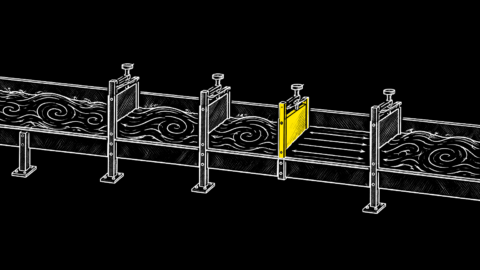
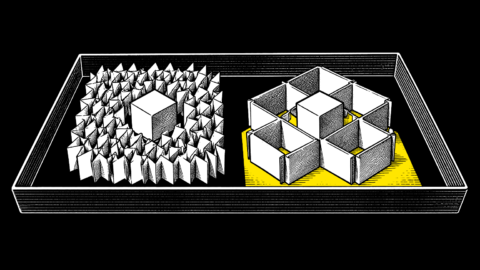
Researchers at the University of Southern California (USC), the software company Quantum Elements, and Madrid’s Instituto de Física Teórica ran the surface code on IBM’s heavy-hex Heron processors and reduced one type of logical error at a time as they enlarged the code. They published the results in Nature Communications on July 29, 2026. Quantum Elements announced the work on September 15 in a release that also names USC.
The surface code is an error-correcting code that stores one logical qubit, an error-protected unit of quantum information, across a grid of physical qubits. A code’s distance is a measure of how many physical errors it can withstand before the logical qubit fails. Subthreshold scaling means that a code with a larger distance has a lower logical error rate, something that happens only when the hardware’s physical error rates are low enough.
On IBM’s heavy-hex Heron chips, the team suppressed one type of logical error at a time as it grew the code and saw both types suppressed together only as an onset late in the runs on a second processor.
How the team mapped the code
In the standard surface-code layout, each qubit away from the edges connects to four neighbors. On IBM’s heavy-hex lattice, no qubit connects to more than three.
The researchers embedded the code on Heron processors with 156 physical qubits through an arrangement they called fold-unfold, built from SWAP gates and extra bridge qubits. A SWAP gate exchanges the states of two neighboring qubits.
In a 2025 theory paper, two of the authors, Cesar Benito and Alejandro Bermudez, had identified an optimized SWAP-based embedding as the most promising route to a “near-term demonstration of quantum error correction advantage” on heavy-hex hardware. They wrote that paper with two colleagues, one of them at IBM.
The team filled idle gaps in the circuits with dynamical decoupling, sequences of control pulses that protect waiting qubits from noise. The authors wrote that the pulses suppressed crosstalk between neighboring qubits and noise that is correlated over time, both of which accumulate during idle periods on heavy-hex layouts.
Quantum Elements later built Orbit, a Qiskit Function, on the decoupling approach, the company said. Qiskit is IBM’s software platform for programming its quantum computers.
Results by error type
The surface code has to guard against two kinds of logical error, bit flips and phase flips. A bit flip is the quantum version of an ordinary computer’s bit error, while a phase flip has no counterpart in conventional computing. A code that is longer in one direction adds protection against only one of the two.
The team scaled from a distance-3 code on 37 physical qubits to codes of distance 3 in one direction and 5 in the other, each on 65 physical qubits. It ran up to 10 cycles of error correction, with a total of 2,200 entangling gates, the operations that link the quantum states of qubits.
On ibm_aachen, the best-performing processor in the study, the team measured suppression factors of 1.23 to 1.46 for the error type that each lengthened code was designed to suppress, against the average of three distance-3 patches. A suppression factor is a smaller code’s logical error rate divided by a bigger code’s. A factor above 1 means the bigger code had fewer errors.
Against the best single distance-3 patch, the team measured factors of 1.01 to 1.10. When it averaged over all four logical states it prepared, covering both error types, the factors were 0.67 and 0.77. By that measure, the larger codes had more errors overall.
Entanglement fidelity and decoupling
The authors also derived an entanglement fidelity measure that combines both error types and accounts for errors in preparing and measuring the qubits. Fidelity is a score of how closely a quantum state or operation matches its ideal version, with 1 meaning a perfect match. Using that measure, the authors found no subthreshold scaling for arbitrary logical states on ibm_aachen.
On ibm_marrakesh, a second Heron processor, the authors reported the onset of subthreshold scaling in later cycles, with 95% statistical confidence only at the ninth cycle.
The authors wrote that when codes of different sizes are compared, the correct reference is the smaller code run with decoupling. A conclusion of subthreshold scaling drawn from a comparison with the smaller code run without decoupling is spurious, they wrote.
Next steps
Using noise simulations calibrated to the hardware, the authors estimated that cutting current noise rates by about 30%, on a slightly larger heavy-hex processor, would be enough for genuine subthreshold scaling of a code with distance 5 in both directions. They wrote that the existing processors are six qubits short of hosting such a code.
Quantum Elements chief executive Izhar Medalsy said in the September 15 announcement that the work was “just the first step toward implementing entangled logical qubits” and that the company would reveal more details soon.
Authors and funding
Besides Benito and Bermudez, the paper’s three other authors are Arian Vezvaee, Mario Morford-Oberst, and Daniel Lidar. Lidar directs USC’s Center for Quantum Information Science & Technology and is chief scientific officer of Quantum Elements, a company founded in Los Angeles in 2023. Vezvaee, the first author, and Lidar both list Quantum Elements among their affiliations. Bermudez and Lidar supervised the project, according to the paper. No IBM researchers are among the authors.
The team first posted the work as a preprint, a paper shared before peer review, on arXiv in October 2025. IARPA’s Entangled Logical Qubits program, the Army Research Office, and DARPA funded the study. Spanish research agencies, the Spanish National Research Council (CSIC), and the European Union’s Horizon Europe program supported the Madrid authors.