IBM announced on August 19, 2026, that it had joined two cryogenic modules into a single environment and cooled them down together. The company said the two modules, which it described as more than 8 feet tall and 8 feet wide, reached 4 kelvin in under five days and dropped below 15 millikelvin, less than 0.015 degrees above absolute zero, shortly afterward.
Neither module contained a quantum processor during the test. IBM said it will install its Nighthawk processors in the modules later in 2026 to expand performance testing.
IBM has joined and cooled two empty modules, but neither its release nor its technical blog gives the cells’ temperature under a simulated processor load.
How the cells connect
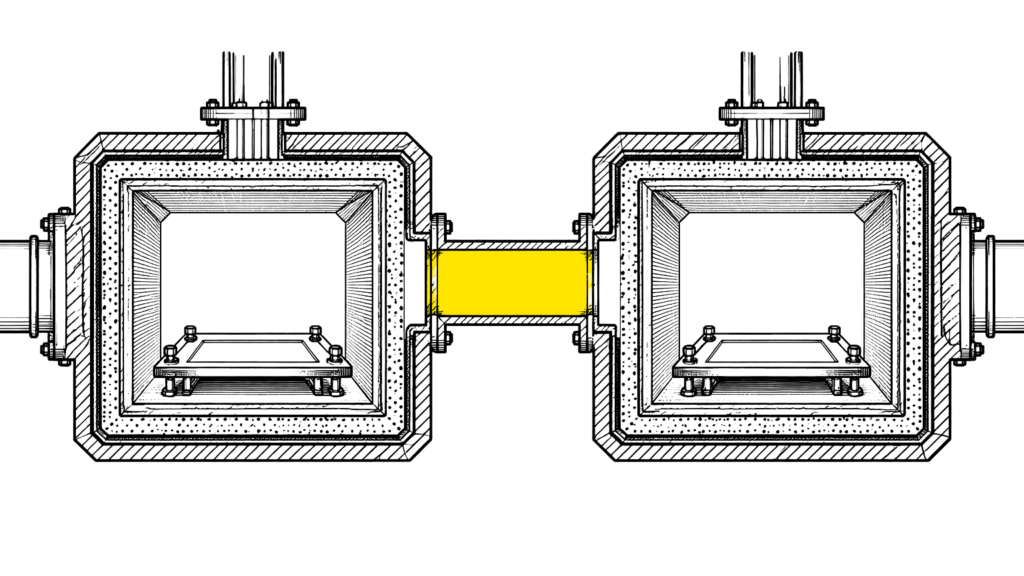
In a technical blog post, Catherine Dundon, Shawn Hall, Matthew Hollister, and Allie Lindler of IBM described the modules as box-shaped cells built from aluminum panels and framing, each with its own vacuum chamber, cooling hardware, and thermal shielding.
When two cells are joined, quantum cables pass through an opening from one cell into the next, the authors wrote. The layers of shielding in the two cells link up to form a protected cryogenic tunnel between them.
The authors wrote that the first two prototype cells had operated together. In the post, IBM captioned a photo of the two connected prototypes as operating in Poughkeepsie, New York. Each cell uses what they called established dilution refrigerator technology. A dilution refrigerator reaches temperatures within thousandths of a degree of absolute zero by circulating a mixture of two helium isotopes, helium-3 and helium-4.
Because the cells are box-shaped, IBM can place them side by side with short interconnect paths between processors, the authors wrote. IBM plans to connect processors in neighboring cells with l-couplers.
An l-coupler is a cable up to a meter long that links separate chips. The company demonstrated the couplers in November 2024 with Flamingo, a proof of concept that linked two chips.
What IBM published and what it told reporters
“Each module’s vacuum enclosure offers up to 12 times more wiring space than the most widely used IBM quantum systems,” IBM’s release said. Oliver Dial, IBM’s vice president of quantum systems, put the comparison at about 12 times the wiring area of Quantum System One, Network World reported. The blog authors listed each cell’s wiring area as about 0.53 square meters and its vacuum chamber as about 2.75 cubic meters.
To simulate installed processors, wiring, and electronics, the team put about 30 microwatts of heat onto the mixing chamber plate, diginomica reported, quoting Dial. The mixing chamber plate is the coldest stage of a dilution refrigerator, where quantum chips are mounted. With that load applied, the cells ran at 23 millikelvin, The New Stack reported.
EE Times and The New Stack reported that IBM’s best two-qubit operation across an l-coupler had a fidelity of 99.3%, against IBM’s target of 99.9%. In an October preprint, IBM researchers gave 99.3% as their best fidelity for transferring a quantum state across a link, a different operation from a two-qubit gate, and 96.42% for their best gate between two processors. Fidelity is a measure of how closely an operation matches its ideal version, on a scale where 100% is a perfect match. IBM did not include the loaded temperature or the coupler fidelity in its release or its technical blog.
Dial wrote to EE Times that the main limit on the coupler’s current fidelity is the coherence of the qubits attached to it. Coherence is a qubit’s ability to preserve its quantum state against noise.
Dial also wrote that replacing any cryogenic component would still require warming and recooling the connected system as a whole. IBM is studying operational redundancy, including a possible fail-in-place approach, EE Times reported. In a fail-in-place design, a failed part is left in the system while the remaining hardware keeps running.
Next steps and roadmap
Diginomica reported that IBM plans to put one Nighthawk processor in each of the two cells to test a quantum link between processors in separate cells. By 2027, IBM plans to use l-couplers to link processors into a computer with at least 1,000 programmable qubits, the release said. IBM defined programmable qubits as “qubits that can be directly used to perform computations.”
In an information sheet dated August 18, IBM wrote that near-term systems would use two to three cells. It wrote that future systems would grow to several tens of modules supporting hundreds of thousands of physical qubits.
The company has said its Starling system, planned for 2029 in Poughkeepsie, will run 100 million quantum operations using 200 logical qubits. A logical qubit is an error-corrected qubit encoded across many physical qubits.
IBM expects Starling to need about 12 modules, The New Stack reported. Diginomica reported that IBM plans for each cell to hold at least 2,000 physical qubits.
Update, November 12, 2026: In an October 21 preprint, IBM researchers, including Dial, reported l-coupler links between two Nighthawk processors of 120 physical qubits each. Their best state-transfer fidelity across a link, 99.29%, rounds to the 99.3% reported in August. Their best two-qubit gate between the two processors had a fidelity of 96.42%. In an October 27 blog post, IBM gave an average of 99% for state transfer and 94.75% for two-qubit gates across four links.