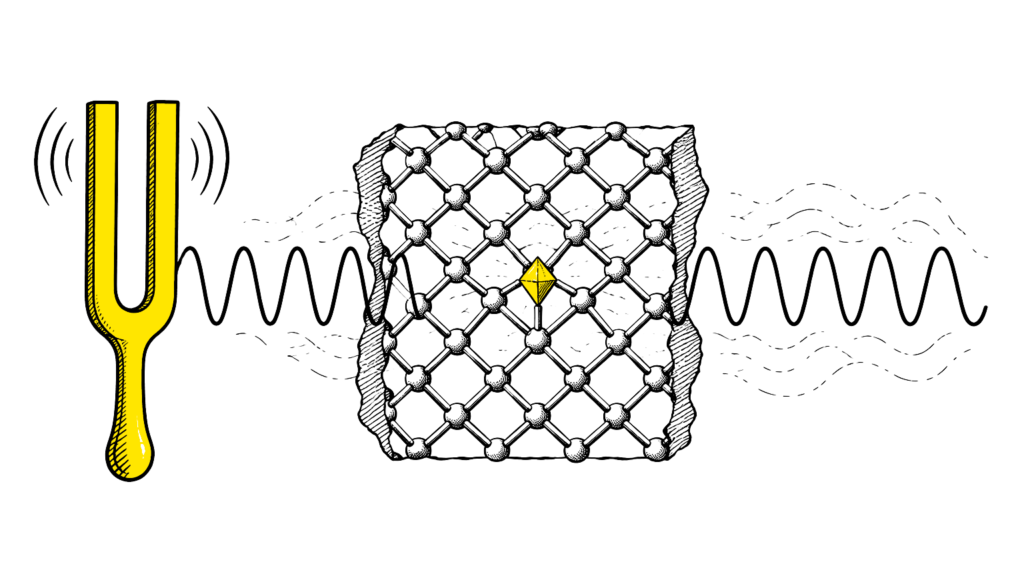
Researchers at Harvard’s John A. Paulson School of Engineering and Applied Sciences reported in Nature Physics on July 15, 2026, that they had protected a qubit in diamond from low-frequency noise using sound instead of microwave pulses. The qubit was the electron spin of a silicon-vacancy center, a defect in which a silicon atom occupies the space between two neighboring vacant carbon sites in the diamond lattice.
Harvard announced the work on August 25 and said the researchers had extended the spin’s coherence time by roughly a factor of three. The team measured the improvement in the spin’s dephasing time, written T2*. Dephasing time is how long a qubit left alone keeps a predictable phase before slow fluctuations in its surroundings scramble it.
The team demonstrated the protection on a single spin with sound waves traveling across a test chip, outside the phononic cavities that Harvard said would connect qubits in a future quantum network. A phononic cavity is a structure that traps mechanical vibrations and makes them interact strongly with a qubit’s spin.
Sound in place of microwaves
Marko Lončar, the Tiantsai Lin Professor of Electrical Engineering, leads a group that is building phononic cavities to link qubits with sound, Harvard said. Phonons are the quantum units of vibration, as photons are of light.
Harvard said the microwave pulses used in existing protection methods do not work well on qubits housed in phononic cavities. “We want the spin to have strong interaction with phonons, and we want the spin to have a long coherence time,” said Eliza Cornell, who co-led the experiments with Zhujing Xu.
Cornell completed her Ph.D. in Lončar’s lab and is now a postdoctoral researcher at Boston University. Xu is a former postdoctoral scholar in the group. The Nature Physics paper lists the two as equal contributors.
How the experiment worked
According to the team’s preprint, posted in August 2025, metal electrodes called interdigital transducers, patterned on a 1.4-micrometer layer of aluminum nitride on a diamond chip, launched surface acoustic waves across the chip. Two of those waves, traveling in opposite directions, were focused on a single silicon-vacancy center inside a dilution refrigerator. A dilution refrigerator is a cryogenic cooler that can bring a sample to within a fraction of a degree of absolute zero.
When a spin is driven continuously at its resonance frequency, the spin and the driving field combine into what physicists call dressed states. Harvard said the dressed state is less sensitive to low-frequency environmental noise than the bare, undriven spin.
In the preprint, the team reported a dephasing time of 680 nanoseconds for the bare spin and 2.2 microseconds for the dressed spin, a ratio of about 3.2. The authors wrote that they saw the extension despite heat the acoustic drive adds to the sample.
The sample stage, where the chip is mounted, was at 250 millikelvin when the team measured the dressed spin and at 45 millikelvin when it measured the bare spin. One millikelvin is a thousandth of a degree above absolute zero.
The researchers also drove the bare spin at a Rabi frequency of 800 MHz, a figure they reported in the Nature Physics abstract. A Rabi frequency is the rate at which a drive rotates a spin between its two states. The higher that rate, the faster a qubit can be controlled.
In the preprint, the team reported using a drive power of 10 milliwatts to reach 800 MHz. For the dressed-state measurements, the researchers used a dressing drive with a Rabi frequency of 76 MHz.
Limits and next steps
In the Nature Physics abstract, the authors wrote that their results “establish a basis for high-fidelity, phonon-mediated quantum gates.” In such a gate, phonons would transfer quantum information between qubits. The team tested neither a phonon-mediated gate between qubits nor a spin inside a cavity.
Co-authors came from the University of Chicago, Argonne National Laboratory, the Walther-Meißner-Institut in Garching, Germany, and the Technical University of Munich. Harvard said the work was supported by the National Science Foundation, the Air Force Office of Scientific Research, and Q-NEXT, one of the Department of Energy’s national quantum centers. The paper lists further funders.
Harvard’s Office of Technology Development is pursuing patent protection and commercialization opportunities for the work, the university said.