IBM gives two numbers for each fault-tolerant machine on its roadmap. Starling, due in 2029, is to run 100 million gates on 200 qubits, which IBM specified as logical qubits in a June 2025 announcement. Blue Jay, dated “2033+”, is to run 1 billion gates on 2,000 logical qubits. A logical qubit is a unit of error-corrected quantum information spread across many physical qubits, the devices on the chip.
IBM’s researchers are much further along on logical qubits than on gates. In a November 5, 2026, release with Oak Ridge National Laboratory and AMD, IBM wrote that its experiments had demonstrated “up to 70 logical qubits and 438 hard operations,” without saying whether one experiment reached both. The Department of Energy (DOE) defines a hard operation as one that is difficult in a machine’s error-correction scheme but needed for universal computation, such as a non-Clifford gate. IBM put the distance to DOE’s first-generation target of 100,000 such operations at “a roughly 230-fold increase in hard operation count.”
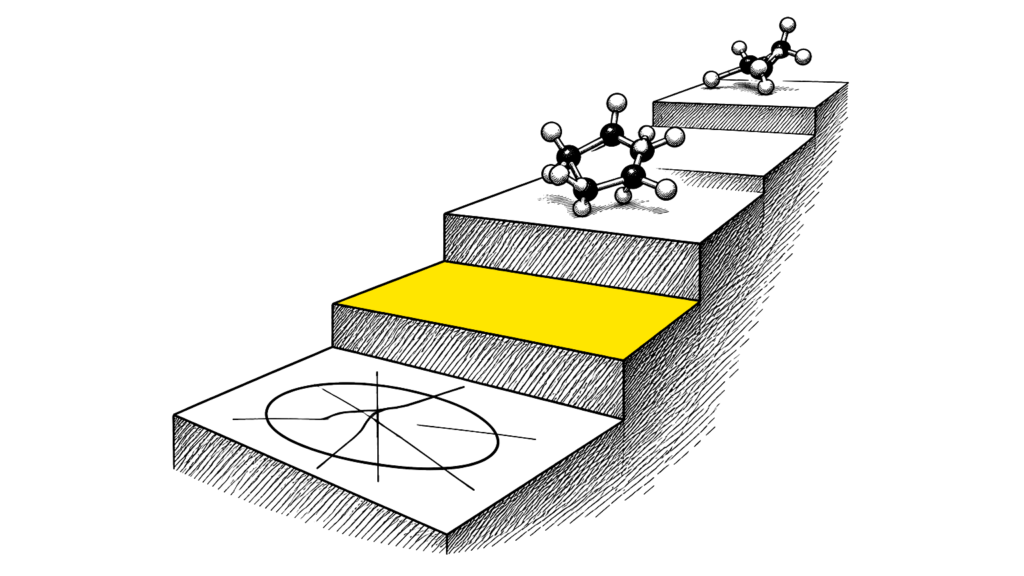
Researchers who cost fault-tolerant applications find the same imbalance. A utility ladder is a ranking of applications in the order a growing machine could run them. Ranked by the non-Clifford gates each one needs instead of by logical qubits, the list of applications within reach of announced machines is shorter than roadmaps imply. On that ranking, breaking a 256-bit elliptic-curve key comes before every molecular ground-state estimate that Google Quantum AI researchers compiled in 2025.
Four resources behind one headline number
A fault-tolerant machine spends four resources on an algorithm. Width is the number of logical qubits in use at once, including those that store intermediate results.
The non-Clifford count is the number of T or Toffoli gates in the circuit. The surface code and most other leading codes cannot apply these gates directly. In those designs the machine consumes a specially prepared “magic state” for each one, made in regions of the chip called factories, although some codes reach the same gates by other routes.
The third resource is the logical error budget, the number of operations a run can complete with a good chance of no logical error. A run of 1 billion operations finishes cleanly only if each operation fails much less often than once in 1 billion attempts. The fourth is speed, the number of logical operations the machine completes per second. A gate count divided by that rate is the runtime.
Engineers trade physical qubits for logical ones at a rate fixed by the error-correcting code. IBM researchers reported in Nature in 2024 that their gross code could preserve 12 logical qubits “using 288 physical qubits in total.” For the surface code, the standard design, the same memory “would require nearly 3000,” they wrote.
Google’s team reported in 2024 that on its Willow processor the logical error rate fell by a factor of 2.14 each time the team increased the code distance by two. A code’s distance is the smallest number of physical errors that can change the stored information without being detected.
In October 2026, Google researchers reported in Science that they had prepared a magic state for a T gate on Willow with a method called cultivation, reaching a fidelity of 0.9999, or an error of about 1 in 10,000. Craig Gidney of Google Quantum AI had assumed cultivated states with errors of 1 in 10 million in his 2025 estimate for factoring a 2048-bit RSA key, and he purified those states further before use.
What announced machines would supply
Builders and funders pair the logical-qubit count with a second number but state it in different units. In the published figures below, IBM counts gates on its roadmap, DOE counts hard operations, and Quantinuum and IonQ give logical error rates.
| Machine or target | Logical qubits | Second number | Source |
|---|---|---|---|
| IBM experiments by November 2026, not necessarily one run | up to 70 | 438 hard operations | IBM, ORNL and AMD |
| DOE prototype, illustrative | 10 | 1,000 hard operations | DOE request for applications |
| DOE first-generation machine, illustrative | 100 | 100,000 hard operations | DOE request for applications |
| DOE next-generation machine, illustrative | 1,000 | 10 million hard operations | DOE request for applications |
| IBM Starling, 2029 | 200 | 100 million gates | IBM roadmap |
| IBM Blue Jay, “2033+” | 2,000 | 1 billion gates | IBM roadmap |
| Quantinuum Apollo, 2029 | “hundreds” | logical error rate “better than 10⁻⁶” | Quantinuum and its third-quarter 2026 release |
| IonQ, 2030 | 80,000 | logical error below 10⁻¹² | IonQ roadmap |
IBM’s roadmap page does not say whether its gate counts include Clifford operations, which error-corrected machines run cheaply. DOE published its figures in September for the Q Competition, its contest to build the first scientifically useful fault-tolerant machines. It wrote that “a specific realization at any generation may differ.” DOE also wrote that first-generation machines would be “capable of performing thousands of hard fault-tolerant operations,” fewer than its table lists.
At a logical error rate of 1 in a million per operation, a run of a million operations finishes without an error about 37% of the time, and a run of 10,000 operations about 99% of the time. Each error target therefore sets a gate budget once a planner fixes the chance of a clean run.
A Sandia-led team of 30 researchers wrote in a September preprint that “current QUOPS scores are insufficient by roughly five orders of magnitude” for factoring RSA-2048 or for estimating an energy level of FeMoco, the metal cluster at the core of the enzyme that fixes nitrogen. Under the team’s QUOPS benchmark, a machine’s score is the size of the largest circuit it runs reliably.
What published algorithms require
In the table below, published estimates are ranked by Toffoli count. A Toffoli gate acts on three qubits. Joonho Lee and colleagues wrote that “a Toffoli gate is roughly twice the cost of a T gate within the surface code.”
Ryan Babbush and eight co-authors compiled the figures for eight rows from their own estimates and other groups’ in a November 2025 perspective, drawing on “insights from the Google Quantum AI team.” They cited PsiQuantum researchers for the Hubbard quench and researchers at PsiQuantum and Mercedes-Benz for the battery electrolyte. For the Heisenberg quench, they cited Yunseong Nam of IonQ and Dmitri Maslov of the National Science Foundation, who counted 6,751,395 T gates on 131 qubits in 2019. For the three condensed-matter simulations, the Google authors gave single-run figures.
| Application | Logical qubits | Toffoli gates | Runtime | Source |
|---|---|---|---|---|
| 2D Ising model quench, 121 sites | 140 | 4×10⁴ | about 1 second | Google Quantum AI perspective, 2025 |
| 2D Hubbard model quench, 128 spin orbitals | 160 | 1×10⁶ | not given | Google Quantum AI perspective, 2025 |
| Heisenberg model quench, 70 sites | 131 | 6×10⁶ | not given | Google Quantum AI perspective, 2025 |
| Breaking a 256-bit elliptic-curve key | fewer than 1,200 | fewer than 9×10⁷ | minutes | Google-led whitepaper, 2026 |
| Ruthenium catalyst for carbon fixation, 56 orbitals | 900 | 2×10⁸ | not given | Google Quantum AI perspective, 2025 |
| Cytochrome P450 enzyme, 58 orbitals | 1,200 | 5×10⁸ | not given | Google Quantum AI perspective, 2025 |
| Factoring RSA-2048, one of about nine expected runs | about 1,400 | about 7×10⁸ | about 12 hours | Gidney, 2025 |
| FeMoco nitrogen fixation, 76 orbitals | 1,500 | 1×10⁹ | 9 hours | Google Quantum AI perspective, 2025 |
| LiPF₆ battery electrolyte, 116 orbitals | 18,000 | 9×10¹¹ | not given | Google Quantum AI perspective, 2025 |
| Hidden Matching at break-even | 581 | 8.68×10¹⁴ | not given | JPMorganChase and Quantinuum, 2025 |
| Stopping power for fusion, 218 electrons | 6,200 | 1×10¹⁵ | not given | Google Quantum AI perspective, 2025 |
Measured against these demands on width and gate count alone, the announced budgets pass a first screen for a short list. Starling’s 100 million gates on 200 logical qubits would be enough, on those two counts, for the three condensed-matter quenches, single runs of simulations of interacting particles on a lattice. If every one of Blue Jay’s billion gates were a Toffoli, the most generous reading, the machine would pass the same screen for the rows through FeMoco, including each RSA-2048 run. Whether either machine could run them depends on a compilation into IBM’s gate set and on its error, routing, and runtime budgets. It would fall short by a factor of 900 on the battery electrolyte, nearly a million on Hidden Matching and a million on the fusion calculation.
On width alone, Blue Jay would have room for nine of the 11 rows, Hidden Matching among them. Its gate budget, read generously, fits eight.
If each Toffoli counts as one hard operation, DOE’s next-generation target of 1,000 logical qubits and 10 million hard operations would also cover the three quenches. Its first-generation target covers none of the rows as written. Each quench needs more than 100 logical qubits.
In choosing its priority applications, DOE looked for problems where “small demonstrations would be feasible” on first-generation machines and set no problem sizes. Quantum Observer reported on the eight science problems DOE named in October.
More width and fewer gates in chemistry
The FeMoco estimates are the clearest case for reading logical qubits and gates together. In their 2021 paper on tensor hypercontraction, Joonho Lee and colleagues tabulated successive estimates for one 54-orbital model of the cluster. The first, published by Markus Reiher and colleagues in 2017, needed 111 logical qubits and 5.0×10¹³ Toffoli gates. Lee’s team estimated 2,142 logical qubits and 5.3×10⁹ Toffolis for the same model and put the requirement at about 4 million physical qubits and under four days.
Width rose about 19-fold. Over the same four years, the gate count fell almost 10,000-fold. Anyone ranking applications by logical qubits would have moved FeMoco later at the moment its estimate became practical.
Researchers kept cutting gates on the larger 76-orbital model. Lee’s team had put it at 2,196 logical qubits and 3.2×10¹⁰ Toffolis. In their 2025 table, the Google Quantum AI authors put it at 1,500 logical qubits and about 10⁹ Toffolis. In a paper published in Physical Review X in October 2025, Guang Hao Low and colleagues reported “a factor of 4 to 195 speedup over the state of the art” in ground-state energy estimation for iron-sulfur complexes and a carbon-fixation catalyst.
In a December 2025 preprint, Xanadu researchers estimated 180 to 350 logical qubits and Toffoli depths between 10⁷ and 10⁹ for photosensitizers used in cancer therapy. Depth is the length of the longest chain of Toffolis that must be executed in sequence. In their resource table, the authors listed up to 5.78×10⁹ Toffolis per shot, above the abstract’s upper bound.
Eighteen researchers including John Preskill and Garnet Chan examined how classical methods perform on such problems in a 2023 analysis in Nature Communications. They concluded that “evidence for such an exponential advantage across chemical space has yet to be found.”
Quantinuum and SoftBank describe the chemistry limit in logical error rates. In a July 2026 white paper, the two companies mapped about 10 spin orbitals at a logical error rate near 10⁻³ on today’s Helios and about 100 at 10⁻⁷ on Apollo in 2029. The 76-orbital FeMoco model has 152 spin orbitals.
The companies placed chemical accuracy on Lumos, a 2030s machine, at logical error rates of 10⁻¹⁰ or below. They called their roadmap “an assumption-driven envelope rather than a deterministic forecast.”
Speed is the first limit in finance
Researchers who cost finance and optimization problems find that the limiting resources are gate rate and gate count. In a 2021 paper in PRX Quantum on speedups of the kind Grover search offers, Ryan Babbush and five Google colleagues concluded that “quadratic speedups will not enable quantum advantage on early generations of such fault-tolerant devices unless there is a significant improvement in how we would realize quantum error-correction.” They reached the same conclusion for logical gates an order of magnitude faster.
In 2020, Yuval Sanders and colleagues put quantum-accelerated simulated annealing at “roughly a day and a million physical qubits” for spin-glass problems that the classical version solves “in about four CPU-minutes.”
Estimates whose authors did not state Toffoli counts are in the table below, with their sources.
| Application | Logical qubits | Gate count or depth | Speed or runtime | Source |
|---|---|---|---|---|
| Derivative pricing, benchmark cases | 8,000 | T-depth 5.4×10⁷ | must finish in about 1 second | Goldman Sachs and IBM, 2021 |
| Derivative pricing, signal-processing method | 4,700 | 10⁹ T gates | 45 MHz T-gate rate | Stamatopoulos and Zeng, 2024 |
| Portfolio optimization, 100 assets | 8×10⁶ | 7×10²⁹ T gates | not given | Dalzell and co-authors, 2023 |
| Molecular vibration spectra | fewer than 300 | not given | about 3 months at 1 MHz | Szczepanik, Nagy and Zak, 2025 |
| Streaming classification | fewer than 60 | not costed | not given | Zhao and co-authors, 2026 |
For derivative pricing, Goldman Sachs and IBM researchers found that their 54-million-layer circuit would have to run “at the order of a second,” about 54 million T-gate layers per second. Nikitas Stamatopoulos and William Zeng of Goldman Sachs later cut the requirement to 4,700 logical qubits and 10⁹ T gates “at a rate of 45MHz.”
Gidney estimated that his 2025 RSA-2048 design would complete 6.5 billion Toffolis in 4.96 days, an average of about 15,000 per second. The finance circuits call for tens of millions of T gates or T-gate layers per second. Those rates are thousands of times higher, though an average Toffoli rate in one factoring design is not directly comparable with a T-gate rate or a layer rate in another architecture.
Alexander Dalzell and 10 co-authors estimated that a quantum interior-point method for a 100-asset portfolio would need 8 million logical qubits and 7×10²⁹ T gates. They concluded that “fundamental improvements to the QIPM are required for it to lead to practical quantum advantage.”
Michał Szczepanik, Ákos Nagy and Emil Zak of BEIT estimated that even a narrow machine would need months for their spectroscopy calculation, “about three months on a 1 MHz fault-tolerant quantum processor with fewer than 300 logical qubits.”
Quantum memory advantages
In an April 2026 preprint, revised on October 1, Haimeng Zhao, Hsin-Yuan Huang and five co-authors at Caltech, Google Quantum AI, MIT and Oratomic proved an exponential quantum advantage in memory. The advantage applies to classification, dimension reduction and a linear-system task on classical data, when the machine “observes one classical data sample z at a time.”
In the authors’ words, the advantage “persists even if classical machines are granted unbounded computation time.” In simulations on movie-review and single-cell RNA data, they reported “four to six orders of magnitude reduction in size with fewer than 60 logical qubits.”
They also wrote that the runtime is dominated by data loading that grows with the size of the dataset, which is “unavoidable since each gate has only a constant number of degrees of freedom.” In their discussion, they extrapolated the memory scaling to devices with hundreds of logical qubits “while ignoring the same Õ(N) runtime overhead,” the data-loading time. The authors gave no fault-tolerant cost for their own algorithms.
In 2018, Ewin Tang designed a classical algorithm and showed that a leading quantum recommendation algorithm, one of the earlier claims of exponential speedup for machine learning, “does not in fact give an exponential speedup over classical algorithms.” Tang compared running times. The Zhao team proved a separation in memory, a quantity Tang did not bound.
The nearest costed relative is Hidden Matching, a problem with a proven exponential space advantage for streaming algorithms. In a November 2025 preprint, Pradeep Niroula and colleagues at JPMorganChase and Quantinuum described running its core step on Quantinuum’s Helios computer for graphs of 4 to 32 nodes and then compiling the algorithm for fault-tolerant machines.
The team found break-even with the best classical method at about 10¹² nodes, requiring 581 logical qubits and 8.68×10¹⁴ Toffoli gates. They put that at about 53,000 physical qubits with bivariate bicycle codes at a physical error rate of 1 in 10,000, or 1.36 million with surface codes at 1 in 1,000, without giving a runtime. At one Toffoli per microsecond in sequence, 8.68×10¹⁴ of them would take about 27.5 years. Hidden Matching needs fewer logical qubits than any chemistry estimate in the Toffoli ranking and more Toffolis than any of them.
Cryptanalysis on the same scale
On this scale, the elliptic-curve estimates come before every molecular ground-state estimate. In their 2025 perspective, the Google Quantum AI authors listed a 256-bit elliptic-curve attack at 5×10⁷ Toffolis on 3,000 logical qubits, citing Daniel Litinski of PsiQuantum. Ryan Babbush, Craig Gidney, Dan Boneh and six co-authors brought the width below 1,200 logical qubits with fewer than 90 million Toffolis in a March 2026 whitepaper. They gave a second configuration with fewer than 1,450 logical qubits and fewer than 70 million Toffolis.
They estimated that such circuits “can execute in minutes using fewer than half a million physical qubits” on superconducting hardware with physical error rates of 1 in 1,000. For one point addition, the step Shor’s algorithm repeats, Jieyi Long posted an 893-logical-qubit circuit to the ECDSA.Fail benchmark in October.
Counted per run, RSA-2048 comes after the P450 enzyme and before FeMoco. Gidney estimated in 2025 that factoring it would take about nine runs of about 12 hours each, on about 1,400 logical qubits. Each run would use about 7×10⁸ Toffolis, for an expected total of 6.5 billion.
In October, Alice & Bob estimated that 22,593 physical cat qubits could factor RSA-2048 in 3.14 days if bit-flip errors are eliminated. The authors expected about 9.6 runs per factorization, each using 1,433 logical qubits and about 760 million Toffolis, fewer than in the FeMoco row. Iceberg Quantum put the requirement at 72,000 physical qubits for 3.7 days at a 0.1% physical error rate, in an update published without a paper.
A machine that runs the FeMoco calculation in Google’s table would have more than 10 times the gate budget the 2026 elliptic-curve circuits need, on more logical qubits. An organization that treats a molecular ground-state result such as FeMoco as its signal to migrate would get the signal after the elliptic-curve capability exists. In its final transition plan, published on October 27, 2026, NIST deprecates RSA and elliptic-curve cryptography at every approved key size after 2030.
The case for counting logical qubits
On its roadmap, IonQ promises “80,000 logical qubits by 2030” and gives no logical clock rate for that machine. In its Q Competition, DOE ties two $50 million bonus pools to 150 and 200 logical qubits, “in addition to meeting other goals” of a first-generation machine. No bonus rewards more hard operations.
The strongest argument for ranking by width is based on error correction itself. Google’s team measured an exponential fall in logical error rates with code size on Willow. A builder that can afford more physical qubits per logical qubit can therefore buy a larger gate budget.
Algorithm designers also keep cutting gate counts. On this view, a machine with a fixed number of logical qubits can run more applications each year.
Algorithm designers have cut gate counts, sometimes by adding logical qubits. Between 2017 and 2021, they reduced the count for the 54-orbital FeMoco model by four orders of magnitude while raising its logical-qubit count 19-fold. On the 76-orbital model, both numbers fell between Lee’s 2021 estimate and Google’s 2025 table, the Toffoli count about 30-fold and width by about a third. In both series, the gate count changed far more than the width.
Builders who enlarge their codes buy error budget with physical qubits and gain no speed in logical operations.
What would change the ranking
DOE will learn from its Q Competition whether builders report hard operations as readily as logical qubits. DOE anticipates announcing initial selections “no earlier than November 13, 2026,” and a final evaluation of first-generation machines in September 2028. To share the general prize pool, a builder must meet the hard-operation target as well as 100 logical qubits.
The first team to run a fault-tolerant Fermi-Hubbard calculation beyond classical reach, one of DOE’s priority targets, will show when the cheapest applications in this ranking become practical. Earl Campbell estimated that a potentially useful Hubbard simulation would need “around one million Toffoli gates,” a hundredth of Starling’s announced budget.
For machine learning, the test is a fault-tolerant break-even estimate for one of Zhao’s memory-advantage tasks, with its Toffoli count and required clock rate. Quantum Observer found no published fault-tolerant cost estimate for those tasks as of November 2026.
Either of two results would overturn the ranking: a full-scale molecular ground-state estimate below 10⁸ Toffolis with elliptic-curve estimates still near their March 2026 figures, or a builder whose gate budget grows as fast as its logical-qubit count. Until either appears, the billion gates IBM gives for Blue Jay are a better guide to what that machine could run than its 2,000 logical qubits.