The U.S. Department of Energy (DOE) released eight Quantum Genesis Priority Applications on October 8, 2026, a set of science problems it will use to judge whether its first fault-tolerant quantum computers are scientifically relevant. Fault-tolerant machines use error correction to keep long calculations running despite faulty components. DOE said it will also use the list to coordinate hardware, software, and domain-science research under Quantum Genesis, its initiative to build and deploy such computers.
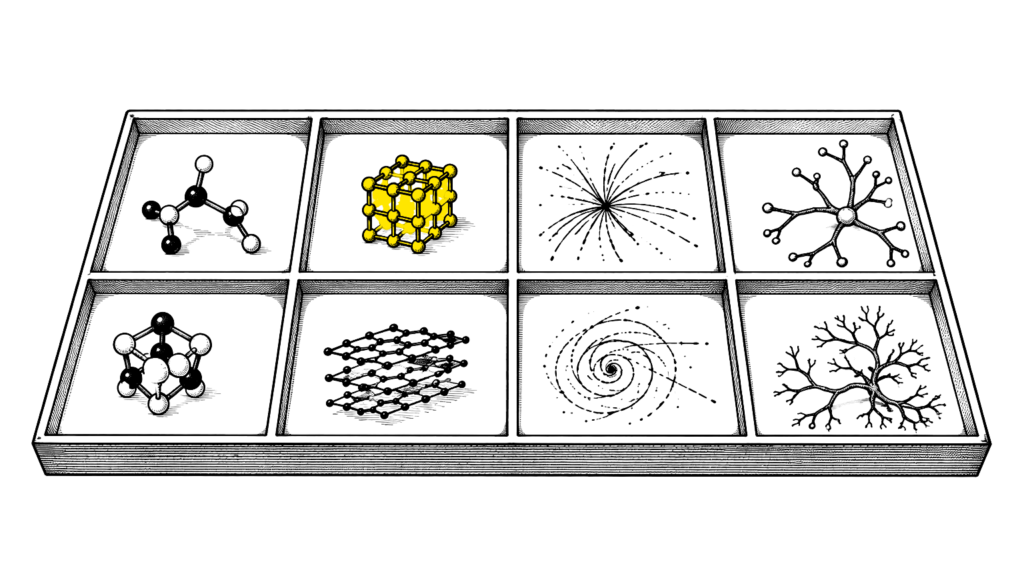
In its priority applications document, DOE grouped the problems into chemistry, materials, subatomic physics, and applied mathematics, four domains in which it expects scientific relevance within five years. Instead of setting target problem sizes, DOE wrote, it selected problems for which small demonstrations would be feasible on the first generation of what it calls scientifically relevant quantum computers, or SRQCs.
DOE has named the science it wants first from fault-tolerant machines but has not said how large a calculation must be to count. It defines an SRQC as a fault-tolerant quantum computer that solves problems of interest to its science mission. Relevance is judged by “the result itself, not the machine that produced it,” DOE wrote.
The eight applications
In chemistry, DOE named two applications, the mechanisms of reactions in complex chemical systems and the dynamics of those reactions. In materials, it named two more, the ground and equilibrium states of quantum materials and the dynamics of materials pushed out of equilibrium or into extreme environments.
The three subatomic physics applications are the dynamics of matter governed by the strong nuclear force and its approach to thermal equilibrium, physics at high density, and nuclear structure and interactions. The eighth application, in applied mathematics, is linear systems and partial differential equations. Scientists use such equations to model fluid flow and many other physical processes.
DOE gave two to five example targets for each application. One is to compute the lowest energy of the Fermi-Hubbard model and the gap above it on lattices larger than classical computers can currently handle. In that model, a standard tool for studying high-temperature superconductors, electrons hop between sites on a lattice and repel each other when they share a site.
Another target is to simulate a turbulent classical fluid flow. DOE wrote that it chose each application for a problem class where “there is a strong scientific basis to believe that classical computers face fundamental scaling challenges.”
DOE listed biological modeling, fusion and plasma science, data analysis, and optimization separately, as emerging areas that it said need further work before they can be firmly prioritized. Under Secretary for Science Darío Gil called the applications “a bold declaration of how quantum computing capabilities will open up new scientific frontiers.” DOE said it will pair domain scientists with quantum researchers and benchmark performance against today’s most advanced supercomputing methods.
The Q Competition
DOE said it will use the list in all three parts of Quantum Genesis: a competition to build fault-tolerant machines, a national quantum computing user facility, and research on applications.
DOE announced the Q Competition on September 17 with up to $215 million in planned funding. DOE said $2.5 million of that is fiscal 2026 money and the remainder is contingent on congressional appropriations.
In the competition’s second phase, DOE will split a $100 million pool evenly among companies that demonstrate a first-generation SRQC with at least 100 logical qubits. A logical qubit is an error-protected unit built from many physical qubits. DOE will divide two more pools of $50 million each among companies that reach 150 and 200 logical qubits.
In the competition’s request for applications, DOE set illustrative targets for three generations of machine, expressed in logical qubits and hard operations. DOE defines a hard operation as one that is difficult in a competitor’s error-correction scheme but necessary for universal computation.
A prototype would have 10 logical qubits and perform 1,000 hard operations. A first-generation SRQC would have 100 logical qubits and perform 100,000. A next-generation SRQC would have 1,000 logical qubits and perform 10 million.
DOE wrote that a real machine at any generation may differ from these figures.
Next steps
DOE expects to announce its first Q Competition selections no earlier than November 13, after applications close on October 19. It anticipates a final evaluation of progress toward the first-generation goal in September 2028. DOE will consider applicants that propose to reach that goal no later than 2030.
DOE has also asked its national laboratories to propose a Quantum High Performance Computing Validation and Verification Testbed, with proposals due on November 10. In its September announcement, DOE said it plans $45 million for the testbed, including $14 million in fiscal 2026.
DOE launched Quantum Genesis on June 23, 2026, one day after President Trump signed Executive Order 14413, “Ushering in the Next Frontier of Quantum Innovation.” In the order, Trump set up an effort to deliver at least one quantum computer for scientific discovery to a DOE facility.
DOE said it is also working with the Department of War, the Laboratory for Physical Sciences, and NASA on quantum applications. On the day DOE released the list, the Department of War announced application workshops that the Defense Advanced Research Projects Agency will run in coordination with DOE’s Office of Science.