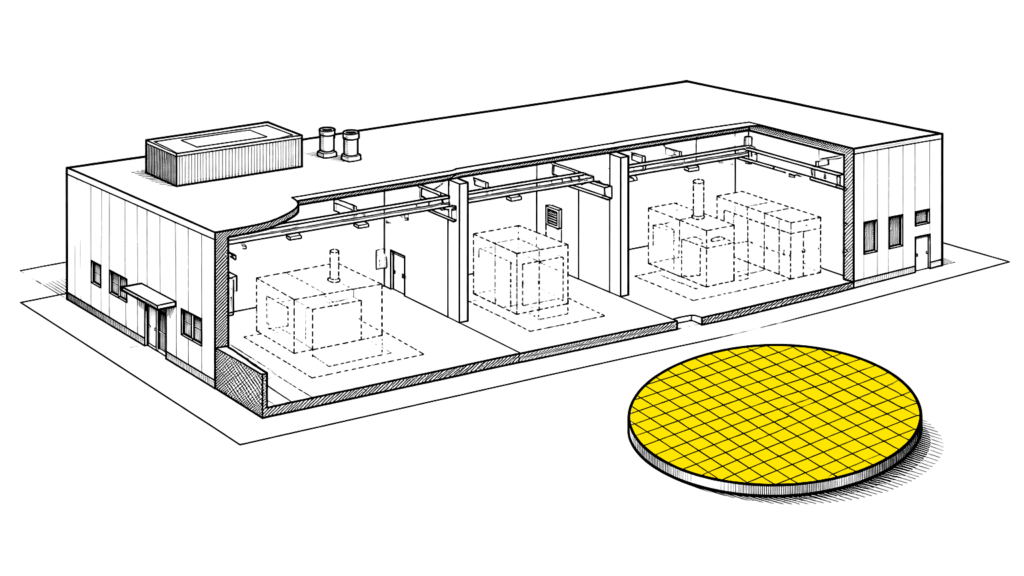
Quantum Foundry Copenhagen and its owner, the Novo Nordisk Foundation, announced plans on September 4, 2026, to build a 5,300-square-meter quantum chip fabrication facility in Copenhagen. The foundation said the facility is expected to open in 2027 and will offer wafer fabrication to quantum technology vendors worldwide on commercial terms. In wafer fabrication, manufacturers build many chips at once on a thin disc of material called a wafer.
The partners named no customers, qubit type, or production volume, so the plant’s offer of wafer fabrication to other quantum companies has no disclosed takers yet.
Bloomberg reported that the investment is about $62 million, a figure the foundation did not give in its announcement. The Danish news agency Ritzau, citing the business daily Børsen, reported that this phase is expected to cost DKK 400 million.
What the plant will do
The foundation said the facility will combine ultra-high vacuum manufacturing capabilities with laboratory space for nanofabrication of quantum materials, advanced characterization, testing, and chip assembly and packaging. In ultra-high vacuum processing, engineers grow and handle materials in chambers emptied of almost all gas to keep contaminants out.
Founded by the foundation in 2023, Quantum Foundry Copenhagen, or QFC, develops proprietary tools, materials, and processes for quantum chip manufacturing. It manufactures quantum materials and devices with ultra-high vacuum techniques and bottom-up engineering “to achieve extreme purity and atomic precision,” the foundation said. In bottom-up engineering, manufacturers build structures up from individual atoms or thin layers of material.
On its website, QFC says it develops wafer-based integrated circuits that include superconducting, semiconducting, and photonic components. Peter Krogstrup, QFC’s chief executive, said in the announcement that the company’s vision is “to become a world-leading quantum chip manufacturer.” He said QFC aims to build quantum production lines and to supply Europe with “advanced, next-generation quantum computing processors.”
The foundation’s quantum program
The Novo Nordisk Foundation, a Danish enterprise foundation established in 1924 with philanthropic objectives, said it has committed more than DKK 2.9 billion, about €390 million, to quantum technologies. Through its wholly owned subsidiary Novo Holdings, the foundation holds a controlling interest in the drugmaker Novo Nordisk and the biotech company Novonesis.
QFC works closely with the Novo Nordisk Foundation Quantum Computing Programme at the Niels Bohr Institute, University of Copenhagen. According to the foundation, the program’s goal is to develop Denmark’s first fully functional fault-tolerant quantum computer before 2034. A fault-tolerant quantum computer uses error correction to keep long calculations running despite errors in its physical components.
European backing
Henna Virkkunen, the European Commission’s Executive Vice-President for Technological Sovereignty, Security and Democracy, said in the announcement that Europe’s quantum ambitions depend on turning “scientific excellence into industrial capability.” She said that stronger European capacity to develop and manufacture quantum chips is essential for competitiveness and technological sovereignty. She linked the plant to the European Chips Act, the Quantum Europe Strategy, and the forthcoming Quantum Act.
In its 2026 work programme, adopted in October 2025, the European Commission listed the Quantum Act as a legislative proposal tentatively timed for the second quarter of 2026. Virkkunen still described the act as forthcoming after that quarter had ended.
Martin Lidegaard, Denmark’s minister of business and competitiveness, said in the same announcement that the plan strengthens Danish quantum research and manufacturing and creates opportunities for companies in the country. The foundation also pointed to Denmark’s forthcoming national quantum strategy, titled From quantum research to quantum industry.
The foundation expects the Copenhagen plant to open in 2027. Its computing program at the Niels Bohr Institute aims to build a fault-tolerant quantum computer before 2034.
Update, November 14, 2026: The European Commission’s indicative agenda dated November 10 lists the Quantum Act for November 24, subject to change. An earlier agenda, dated October 5, had listed it for November 18.