IBM said in a June 2, 2026, release that it plans to invest more than $10 billion in quantum computing over the next five years. It had first disclosed the plan on May 28, in a filing with the Securities and Exchange Commission. The company listed research and development, capital expenditure, manufacturing, partnerships, and mergers and acquisitions among the areas it would fund. IBM did not break the total down by category or by year.
In the release, IBM highlighted a fault-tolerant quantum computer it plans to deliver in 2029 and Anderon, a planned quantum wafer foundry it announced with the U.S. Department of Commerce on May 21. A fault-tolerant computer detects and corrects its own errors during a calculation.
IBM has said Anderon’s launch is subject to definitive documents with Commerce, whose funding for the foundry was still at the letter-of-intent stage on June 2. In a letter of intent, the parties outline the terms of a deal before they sign a binding agreement.
Anderon
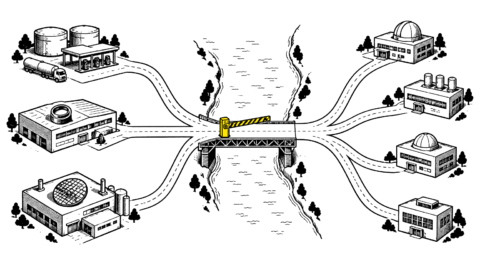
IBM said Anderon will be a standalone company headquartered in Albany, New York, running a 300-millimeter quantum wafer foundry for multiple quantum technology vendors. A 300-millimeter wafer is the standard silicon disc used in high-volume chip manufacturing.
Anderon will first make wafers for superconducting qubits and their supporting electronics, IBM said, with the goal of expanding to other types of qubits. Superconducting qubits, the type IBM uses in its own processors, are circuits that behave as qubits when cooled close to absolute zero.
IBM called Anderon “America’s first pure-play quantum foundry” in its May 21 announcement and “the world’s first pure-play quantum wafer foundry” on June 2. A pure-play foundry manufactures chips for other companies and does not sell chips of its own design.
IBM said it will contribute $1 billion in cash to Anderon, along with intellectual property, assets, and a skilled workforce. The company said it expects additional investors to join as Anderon grows. IBM did not say whether its Anderon contribution counts toward the $10 billion total.
Commerce’s role
Commerce announced on May 21 that it had signed nine letters of intent to provide $2.013 billion in CHIPS and Science Act incentives to quantum companies.
Under its letter, IBM will receive $1 billion in planned funding to establish a new quantum foundry subsidiary for “quantum-grade superconducting wafers,” the department said. Commerce also said it would receive “a minority, non-controlling equity stake in each company” as a condition of the funding. The department did not specify whether the stake tied to IBM’s award would be in IBM or in the new subsidiary.
In the headline of its May 21 release, IBM described the money as a proposed CHIPS award. The company said Anderon’s launch is “subject to the negotiation and execution of definitive documents” with Commerce.
Commerce signed the other letters with GlobalFoundries, for $375 million in planned funding toward a domestic quantum foundry, and with seven quantum computing companies. Atom Computing, D-Wave, Infleqtion, PsiQuantum, and Quantinuum would each receive $100 million, Rigetti up to $100 million, and Diraq up to $38 million.
Starling and Blue Jay
IBM said in the June 2 release that it has “a clear path to delivering IBM Quantum Starling in 2029,” a machine it called the world’s first large-scale, fault-tolerant quantum computer.
When IBM set out the plan in June 2025, it said Starling would be delivered by 2029 and would run 100 million quantum operations using 200 logical qubits. A logical qubit is an error-protected unit of quantum information that a fault-tolerant computer builds from many physical qubits.
IBM said on June 2 that it will build on Starling to develop Blue Jay, a system that “will run one billion quantum operations across 2,000 qubits.” In its 2025 announcement, IBM described Blue Jay’s 2,000 qubits as logical qubits. IBM plans to deliver Starling in 2029, inside the five-year period of the new spending plan.
Advantage and adoption figures
IBM also said it is confident that partners using its quantum computers will demonstrate quantum advantage in 2026. Quantum advantage is the point at which a quantum computer solves a problem more accurately, cheaply, or quickly than classical methods can.
As evidence of “accelerated progress on this path,” IBM cited work with the Cleveland Clinic and RIKEN to model a 12,635-atom protein. In that work, classical supercomputers split the protein into fragments and reassembled the results, and IBM’s quantum processors computed each piece with circuits of up to 94 qubits, according to IBM’s release on the work. It also cited a collaboration with national laboratories and universities to simulate magnetic materials.
IBM said it has made more than 90 quantum systems available worldwide through the cloud and dedicated on-site deployments. It also said it has signed more than $1.1 billion in client contracts for its quantum program since 2017. The company also said nearly 70% of quantum developers use Qiskit, its quantum software development kit.
Update, November 12, 2026: On July 30, IBM and partners including the University of Chicago claimed quantum advantage in work posted as preprints. On September 16, Commerce finalized an award of up to $1 billion to Anderon, which it described as a newly formed IBM subsidiary. Neither Commerce nor IBM mentioned an equity stake in its announcement that day. IBM disclosed Commerce’s stake in its quarterly report on October 22, as Quantum Observer reported. On October 7, DARPA selected IBM for Stage C, the final stage of its Quantum Benchmarking Initiative.