Researchers led by Kejin Wei at Guangxi University in China reported on September 9, 2026, that a standard component of chip-based quantum key distribution (QKD) transmitters gives off faint infrared light that an eavesdropper could separate from the key signal. The team, with co-authors at the National Information Optoelectronics Innovation Center in Wuhan, published the study in the peer-reviewed journal npj Quantum Information after posting a preprint in April.
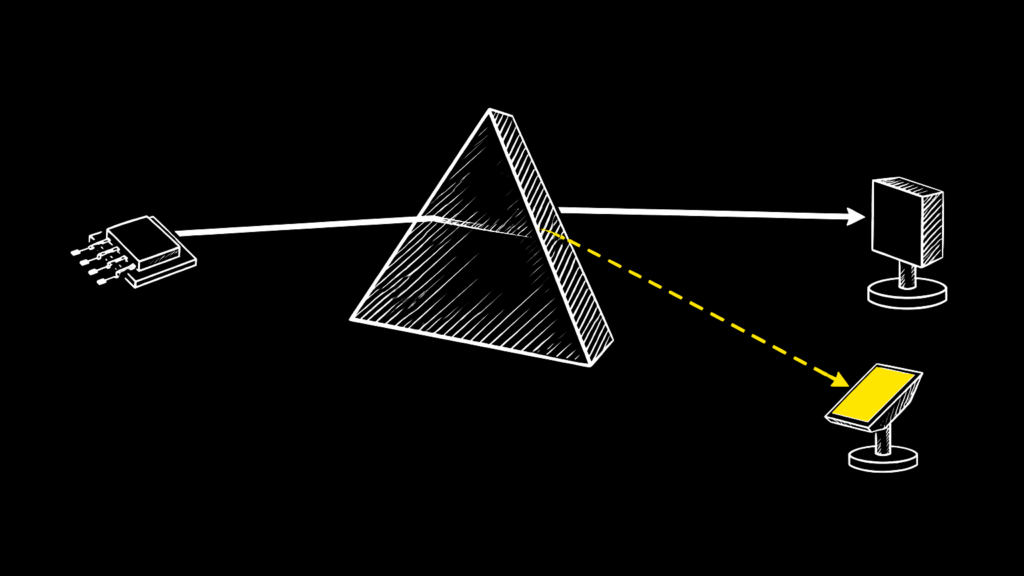
In QKD, two parties build a shared key from single photons or very weak light pulses, and an eavesdropper who measures those signals alters their state and can be detected. That guarantee covers only the signals the security proof models. The component at issue is the variable optical attenuator (VOA), a silicon device that dims light on the chip using a p–n junction. The authors wrote that a VOA under an applied voltage emits light at wavelengths well separated from the telecom band used for the quantum signals.
In worst-case simulations described in the preprint, the authors calculated that the leak could shrink the secure range of a standard QKD link from about 320 to 19 kilometers of fiber. The team measured the light on fabricated chips but did not demonstrate an attack on a working link.
How the leak works
A p–n junction is the boundary between two regions of a semiconductor doped with different impurities. Driving current across it in the forward direction makes some of the moving charges recombine and release light, the same effect that makes LEDs glow.
In the abstract of both the preprint and the journal version, the authors put the emission “centered around 1107 nm.” That is the wavelength expected from silicon’s band gap, the energy that determines the color of the emitted light. Using an interferometer that works at the single-photon level, the authors measured a center wavelength of about 1,078 nanometers in the preprint’s main text and called it “in close agreement” with 1,107. The quantum signals in these systems travel in the telecom C-band, near 1,550 nanometers.
The authors wrote that an eavesdropper could split off the stray light with a wavelength-division multiplexer without disturbing the quantum states. A wavelength-division multiplexer is a passive optical device that separates light by wavelength.
The authors described their work as “the first systematic study of an implementation-level security vulnerability” tied to VOAs built on p–n junctions. They wrote that the spectral separation between the emission and the quantum signals “gives rise to a previously unrecognized wavelength-resolved side channel.” In security engineering, a side channel is an unintended path by which a device leaks information.
Attenuator placement
The authors modeled two transmitter layouts in the preprint. In the first, the VOA is placed before the encoder, the part of the chip that writes key bits onto the light. Stray photons emitted there pass through the encoder and are encoded along with the signal, according to the authors’ model.
The team called this case a “passive Trojan-horse attack.” In a conventional Trojan-horse attack, an eavesdropper shines light into a transmitter and reads the reflections. In the passive version, the transmitter supplies the light itself.
For this layout, the team simulated BB84, the original QKD protocol from 1984, with two decoy states. Decoy states are extra pulses of varied brightness that the sender and receiver use to detect a class of eavesdropping attacks.
At an applied voltage of 2.0 volts with 1.6-nanosecond pulses, the worst case they modeled, the authors calculated a maximum secure distance of 19 kilometers, down from about 320 without the leak. They calculated that the key rate, the speed at which the link generates secret key, would fall by more than an order of magnitude.
In the second layout, the VOA follows the encoder. Unencoded stray photons then reach the receiver, where they add spurious counts and skew the detection-rate estimates that are inputs to the security analysis.
The authors called this the “dual-source flaw.” In the worst case, they estimated a key-rate loss of about 50% at distances under 10 kilometers, according to the preprint. The authors assumed fiber loss of 0.8 decibels per kilometer for the stray light.
In their model, the effect of the second layout became negligible beyond about 15 kilometers.
The test chips
The main test chip was made with CompoundTek’s commercial 90-nanometer silicon photonics process on a 200-millimeter silicon-on-insulator wafer, according to the preprint. Its VOA was about 200 micrometers long.
In the journal’s supplementary information, the authors reported a similar voltage-dependent trend for a second VOA, 318 micrometers long and made on AMF’s foundry platform.
Proposed fixes and next steps
The authors recommended filtering out the stray light by wavelength and choosing VOA drive voltages and pulse widths carefully. They also proposed calibration methods that account for the extra light source.
The authors listed phase modulators and on-chip detectors, for which they reported no emission data, as the next devices to characterize.
They also proposed extending the security analysis to measurement-device-independent QKD and twin-field QKD. In both protocol families, the two users send light to a central measuring station that does not need to be trusted.