IonQ said on October 9, 2026, that its researchers had entangled a trapped-ion qubit with a quantum memory in diamond more than 1,000 times per second over a photonic link. Researchers from IonQ and Duke University described the experiment in a preprint submitted on October 7 that has not been peer reviewed.
The authors reported an average of 1,032 entangled pairs per second at a fidelity of 87.9%, about four times the rate of the fastest earlier photonic link between two trapped ions. Fidelity is a measure of how closely each pair matched the ideal entangled state, where 100% would mean no errors. Two processors that share an entangled pair can use it to run an operation involving qubits in both.
In the same preprint, the authors cited estimates that continuous logical operations between modules of an error-corrected quantum computer need 10,000 to 100,000 entangled pairs per second, roughly 10 to 100 times the rate they measured. A logical operation is a computing step on error-corrected qubits, each encoded across many physical qubits. The authors called their result “a step toward the 10–100 kHz rates required for distributed quantum computation.”
How the link works
A trapped-ion qubit stores information in a single charged atom held in place by electric fields. IonQ’s link joins one barium ion to a silicon-vacancy center, an atomic-scale defect in diamond. The defect is coupled to a nanophotonic cavity inside a refrigerator at about 100 millikelvin, a tenth of a degree above absolute zero.
The ion emits a 493.5-nanometer photon entangled with the ion’s spin, the internal property that encodes its qubit. The researchers shifted the photon to 737.45 nanometers to match the memory, a step called frequency conversion, and re-encoded the photon’s state in its arrival time. The cavity reflects the photon only when the memory’s electron spin is in one particular state.
When a detector registers the reflected photon, the click heralds the pair, meaning the ion and the memory are now entangled. Making 1.1 million attempts per second, the researchers needed an average of 731 attempts to herald each pair, or 969 microseconds once cooling and reset time were counted.
The authors excluded from the headline rate a 664-microsecond measurement that verified each pair. With that step counted, they reported 612 pairs per second. They wrote that “in a distributed quantum computer, gates that consume the pair would take its place.”
Claims and comparisons
In its announcement, IonQ said, “That entanglement rate is fast enough to support distributed quantum computing and other use cases.” The company also called the result “the fastest quantum interconnect rate between qubits of any platform.”
In the preprint, the authors compared their rate with 250 pairs per second, the rate of the fastest earlier photonic link between two trapped ions. Christopher Monroe, IonQ’s co-founder and chief scientist, and his group at Duke reported that result in 2024. IonQ’s new link has an ion at only one end, with the diamond memory at the other.
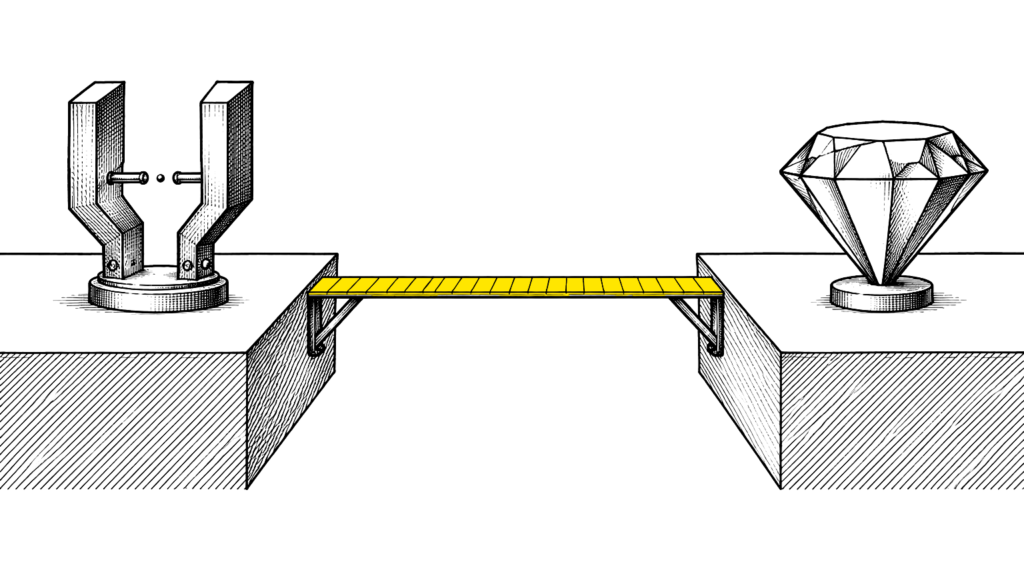
The authors did not report entanglement between two ions through the memory, the step needed to connect separate processors. They wrote that the memory’s silicon-29 nuclear spin, a second qubit inside the diamond, can store entanglement while new links are generated and that these abilities “can be combined to produce ion-ion entanglement between quantum processors.” In this experiment, the team initialized the nuclear spin but did not use it to store entanglement.
Error budget and next steps
In the preprint’s error budget, the authors attributed 4.3 percentage points of the lost fidelity to the ion and 3.9 to the memory. They assigned 2.9 points to frequency conversion and 1.9 to photons that reached the memory but were never detected. From their error model, they predicted a fidelity of 87.4%, in line with the measurement.
The authors wrote that “none of the dominant errors is fundamental.” They projected that better coupling of the ion’s light into fiber, a more efficient signal chain, and a phase-based interaction between the memory’s spin and the photon would raise the rate above 5,000 pairs per second. At that rate, a single link would deliver at least half the 10,000 pairs per second at the low end of the estimates they cited.
In those estimates, each link has an error rate about 10 times that of the two-qubit gates inside each processor. The ion-memory link IonQ measured produced entangled pairs with an infidelity of 12.1%, a figure that is not directly comparable with a gate error rate.
Lightsynq and early sales
IonQ completed its acquisition of Lightsynq, a Boston quantum-memory startup, in June 2025. Lightsynq’s co-founders, Mihir Bhaskar, Bart Machielse, and David Levonian, are among the preprint’s authors.
Bhaskar, now an IonQ senior vice president, said in the October 9 announcement that a photonic quantum interconnect “need not be a bottleneck for distributed quantum computing.” IonQ said it has sold its memory and interconnect platform to the University of Maryland and to SDT in South Korea, in deals announced in April and September.