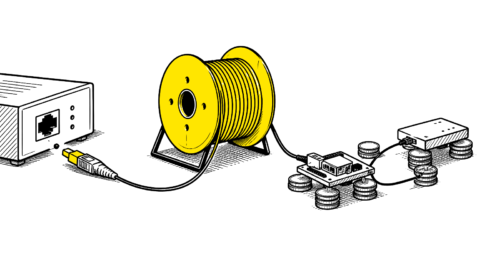
IonQ said on April 14, 2026, that it had photonically interconnected two independent trapped-ion quantum systems in a joint project with the Air Force Research Laboratory. In its announcement, the company called the result “the first demonstration of connected, commercial quantum computers.”
IonQ described both machines as commercial systems but gave no fidelity, entanglement rate, or distance for the link between them. The company cited no paper or preprint and did not say which of its systems it had used.
A photonic interconnect links quantum processors in separate machines with photons, or particles of light. Trapped-ion computers store qubits in individual charged atoms, called ions, held in place by electromagnetic fields. In such systems, each machine can emit photons that are entangled with its ions.
When photons from both machines are measured together, ions in the two machines can become entangled with each other. The two processors can then run operations involving qubits in both machines.
Fidelity is a measure of how closely each entangled pair matches the ideal state, where 100% means no error. The entanglement rate is the number of such pairs a link delivers each second.
What IonQ reported
IonQ said it had validated “the generation, transmission, and detection of photons used to enable quantum entanglement between two commercial IonQ computers at a distance for the first time.” The company did not give the distance, the type of ion, or the wavelength of the photons.
IonQ said the result “reinforces prior lab demonstrations” of photonic links. The only fidelity figure in the announcement was the 99.99% two-qubit gate fidelity that IonQ said it achieved in 2025 and called a world record. Two-qubit gate fidelity is a measure of how accurately a processor performs operations on pairs of its own qubits.
Niccolo de Masi, IonQ’s chairman and chief executive, said the demonstration proves that IonQ’s trapped-ion platform is “uniquely suited for the high-fidelity networking required to solve the world’s most complex problems.”
IonQ said the U.S. government funded the research in part through an agreement with the Air Force Research Laboratory.
DARPA program
On the same day, IonQ said that the Defense Advanced Research Projects Agency, or DARPA, had awarded it a contract in the agency’s Heterogeneous Architectures for Quantum program, known as HARQ. DARPA said on April 14 that it had launched the program. The agency said HARQ seeks to establish “heterogeneous quantum computing architectures that combine different qubit types.”
DARPA listed IonQ among the performers, its term for funded participants, in the program’s Quantum Shared Backbone track. The agency said that track focuses on “creating high-fidelity interconnects that support communication between different types of qubits.” DARPA said the program’s teams would work over the next 24 months.
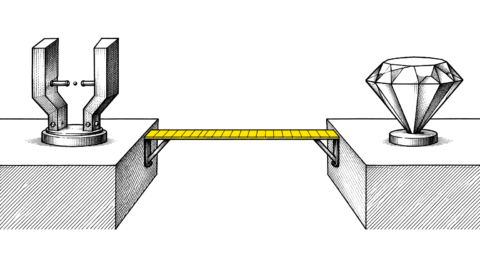
IonQ said its HARQ work “focuses on quantum memories.” A quantum memory stores quantum states, so a link can keep a successful entangled pair while it makes further attempts. IonQ described the memories as the core chips of its quantum interconnect systems and said they are fabricated from quantum-grade synthetic diamond.
IonQ completed its acquisition of Lightsynq, a Boston-based startup specializing in photonic interconnects and quantum memory, in June 2025.
Update, November 12, 2026: IonQ’s later statements on the April link, in its May 6 quarterly results and an October 27 release on $7.5 million in follow-on AFRL funding, gave no fidelity, rate, or distance for it. On October 9, IonQ reported a separate link between a trapped ion and a diamond quantum memory.