Fujitsu said on September 8, 2026, that it had built a working prototype of a diamond-spin quantum computer that integrates tin-vacancy (SnV) centers into photonic integrated circuits, or chips that guide light. The company called it the world’s first working prototype of its kind, a claim it based on its own research in September 2026.
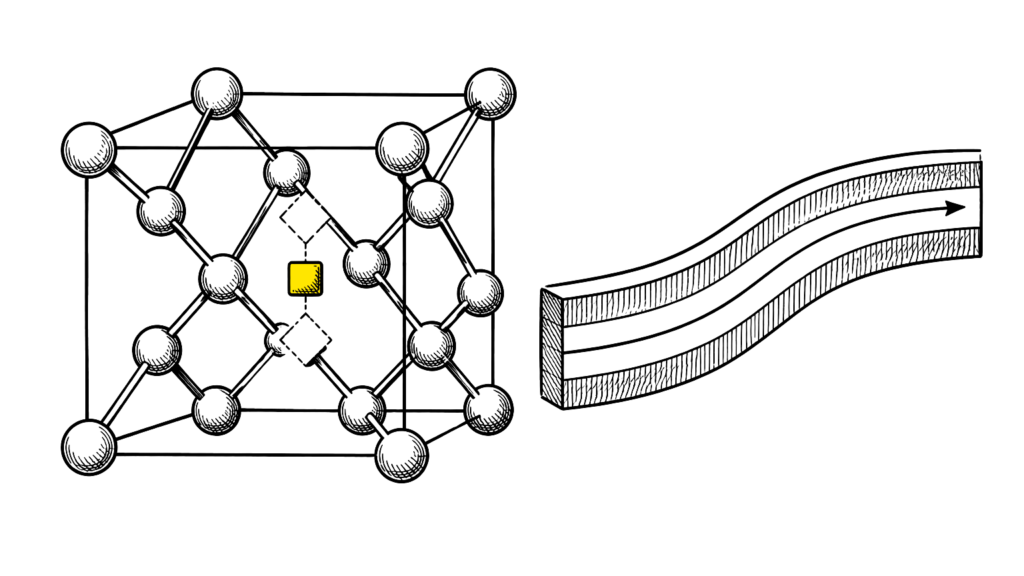
A tin-vacancy center is a defect in diamond made of a single tin atom between two empty sites in the crystal lattice. Diamond-spin computers store quantum information in the spins of electrons at such defects and of nearby carbon-13 nuclei. Spin, a magnetic property of particles, can serve as a qubit.
Fujitsu described how it built and controlled the chip but gave no qubit count, gate fidelity, coherence time, or entanglement rate for the prototype, the figures used to judge how a quantum device performs. Gate fidelity is the accuracy of a device’s logic operations, and coherence time is how long its qubits keep their quantum state. Entanglement rate is how quickly a device can create quantum links between separate qubits.
How Fujitsu built it
Fujitsu said it bonded tin-implanted diamond to alumina/silicon dioxide substrates, then thinned the diamond from several hundred micrometers to several hundred nanometers. The company built photonic circuits that join nanometer-sized diamond crystals containing SnV centers to alumina waveguides, channels that guide light and are transparent to visible light. The waveguides collect the single photons that the centers emit when a qubit is read out.
Fujitsu also developed a way to convert quantum circuits, programs written as sequences of gates, into the combinations of light, microwave, and radio-frequency signals that control diamond-spin qubits. With that conversion, the company said, it had shown in a test environment that the prototype can be used through the Fujitsu Hybrid Quantum Computing Platform “without any additional specialist knowledge.”
Fujitsu said the prototype operates at minus 271.6 degrees Celsius, about 1.55 kelvin, or 1.55 degrees above absolute zero. For comparison, the company gave minus 273.13 degrees Celsius, about 20 millikelvin, as the typical operating temperature of superconducting quantum computers.
Earlier results with NV centers
Fujitsu began the joint research that led to the prototype in 2020 with Delft University of Technology and QuTech, a quantum research institute founded by TU Delft and the Dutch research organization TNO. Fujitsu said it also drew on the results of joint work with the University of Tokyo.
In its release, Fujitsu cited two earlier results from the Delft collaboration, both obtained with nitrogen-vacancy (NV) centers, a different diamond defect from the SnV center. In a March 2025 paper in Physical Review Applied, QuTech researchers and co-authors at the synthetic-diamond maker Element Six reported two-qubit gates with an error probability below 0.1%, using the electron spin of an NV center and the spin of its nitrogen nucleus. They did the work in a joint research program of Fujitsu and TU Delft.
In a May 2026 paper in Nature Communications, QuTech researchers reported entanglement between small groups of NV-center qubits housed in separate cryostats, the refrigerators that cool the qubits. They also reported teleported gates, logic operations performed between the two groups through that entanglement. The authors acknowledged support from the same Fujitsu–TU Delft research program.
In Fujitsu’s release, Kees Eijkel, general director of QuTech, called the prototype a major milestone in the collaboration. “Demonstrating the scalability expected of diamond spin quantum computing remains a long and challenging journey,” he said.
Vivek Mahajan, Fujitsu’s chief technology officer, said the diamond-spin approach “not only offers exceptional scalability in its own right, but also has the potential to be integrated with superconducting quantum computers to further extend their capabilities.”
Fujitsu’s next steps
Fujitsu said it plans to develop a multi-module diamond-spin prototype by 2027. In Fujitsu’s design, a module is the basic unit of a diamond-spin computer. The company plans to grow the system by connecting modules optically.
Fujitsu said it will also begin developing technologies to integrate the diamond-spin approach with superconducting machines. Mahajan tied the work to Fujitsu’s roadmap toward a 250-logical-qubit system by fiscal 2030 and a 1,000-logical-qubit system by fiscal 2035. Logical qubits are error-corrected units, each built from many physical qubits.
In an August 2025 announcement, Fujitsu said the fiscal 2030 system would be a superconducting machine. It said it was targeting the integration of superconducting and diamond-spin qubits from fiscal 2030.