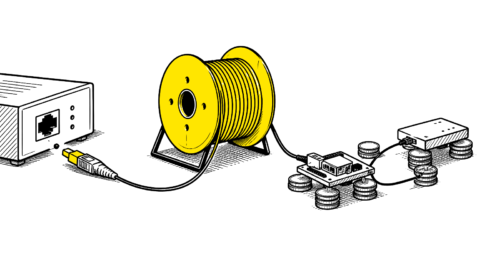
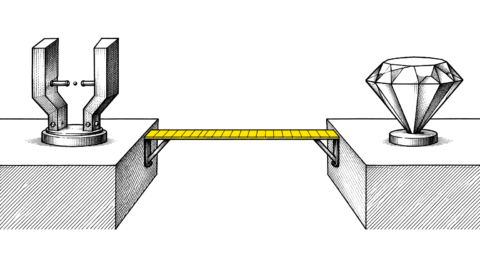
Cisco said on April 23, 2026, that its researchers had built a working research prototype of what it calls the Universal Quantum Switch, a device meant to route quantum information between machines that encode it in different ways. In its announcement, Cisco said that “until now, no switch could accept and translate between all major encoding modalities” and named four encodings the switch is meant to support.
Cisco’s researchers have tested the switch only with polarization-encoded photons and have not yet demonstrated conversion from one encoding to another. Cisco said that “to date, the quantum switch has been experimentally validated with polarization encoding.” The direction in which a light wave vibrates is called its polarization.
Quantum information can be encoded in a photon’s polarization, its arrival time, its frequency, or the path it takes. These encodings are known as polarization, time-bin, frequency-bin, and path. Quantum systems built around different encodings cannot pass quantum states to each other without conversion.
What the researchers reported
Nine researchers, seven of them at Cisco’s Quantum Labs in Santa Monica, California, described the experiments in a preprint posted on April 23 that has not been peer reviewed. The other two authors are at the University of California, Santa Barbara. The prototype is a chip with two inputs and two outputs, made from a thin film of lithium niobate crystal.
Lithium niobate changes how it bends light when heated or when a voltage is applied. The researchers could therefore reconfigure the chip slowly with heaters or quickly with electric fields.
In the slow mode, the authors reported an average fidelity to the input state above 94% and an average purity above 99%. Fidelity is a measure of how closely the output state matches the input. Purity is a measure of how free a state is from random noise.
The authors summarized the switch’s effect as decoherence of 4% or less, which they defined as “the average loss of purity and fidelity compared to the input state.”
In the fast mode, the team drove the switch at a repetition rate of 1 MHz, or a million times a second, while one photon of each entangled pair passed through the chip. The authors reported a fidelity of at least 90% between the input and output states in that test and decoherence of 5% or less for fast operation.
Measured and claimed speeds
Cisco said in its announcement that the switch can reconfigure connections “in as little as 1 nanosecond.” In the preprint, the authors wrote that their platform can support reconfiguration speeds up to 1 GHz. For that figure, they drove the switch with a 1 GHz signal and measured the waveforms at its output ports.
The authors reported quantum-state measurements of entangled photons at switching rates of up to 1 MHz. They wrote that, to their knowledge, the work was “the first demonstration of multi-node dynamic entanglement distribution at these speeds.” They also wrote that their setup mimics a three-node entanglement distribution network.
Using a model, the authors projected that decoherence in their design would stay mostly independent of the number of ports. The prototype they built has two inputs and two outputs.
Cisco said the switch operates at room temperature, at standard telecom frequencies, and on standard telecom fiber. The entangled photons in the experiments had wavelengths near 1,550 nanometers, the band that fiber-optic networks use.
Next steps
Cisco said support for time-bin and frequency-bin encoding “is built into the design and represents the next step in Cisco’s ongoing validation process.” The preprint’s authors wrote that they would include conversion between encodings in the next chip they fabricate.
Cisco named IBM, Qunnect, and Atom Computing among its collaborators. In November 2025, IBM and Cisco said they planned to build a network of large-scale, fault-tolerant quantum computers and were targeting an initial proof-of-concept demonstration by the end of 2030.
Update, November 12, 2026: In a version posted on Research Square on September 17 and under review at npj Quantum Information, the same nine authors reported switching at 1 MHz “with an average fidelity of 96% and a purity of 1.” They still reported tests with polarization encoding only.