Qunnect announced on February 18, 2026, that it and Cisco had performed entanglement swapping over 17.6 kilometers of deployed telecom fiber between Brooklyn and Manhattan. Fourteen authors from Qunnect, Cisco, and New York University posted the results on February 17 as a preprint that has not been peer reviewed.
Entangled photons behave as a single system, so measurements on them give correlated results even when the photons are far apart. In entanglement swapping, researchers take two separately entangled pairs of photons and make a joint measurement on one photon from each pair. The two remaining photons then become entangled with each other, although they never interacted.
The team swapped entanglement between two independent sources over installed city fiber at a measured rate above 0.65 per second, with both sources in one Brooklyn building and the swapping measurement made at a Manhattan data center.
Network layout
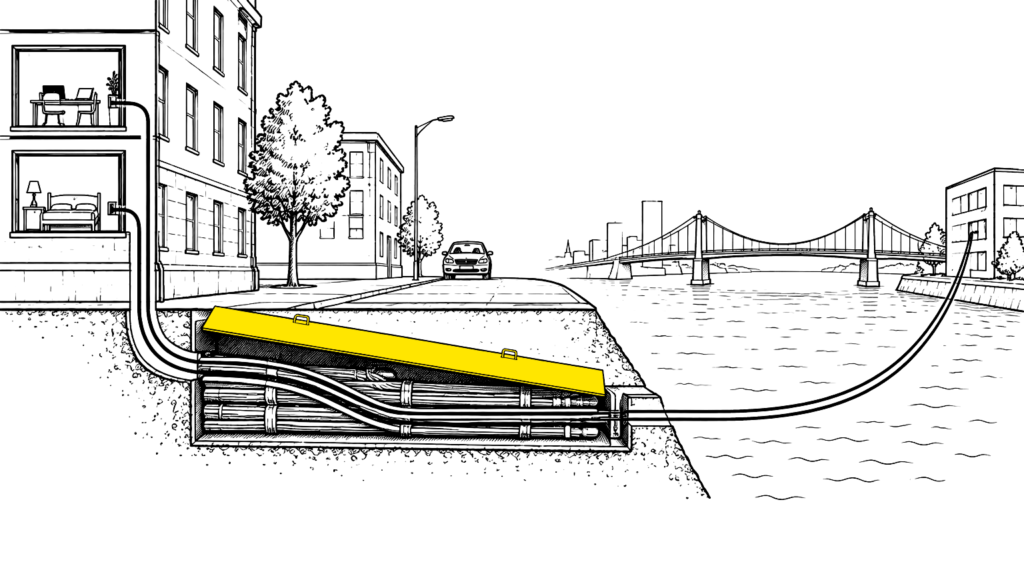
In the preprint, the authors described two sources in separate rooms about 30 meters apart in one building at the Brooklyn Navy Yard. The rooms had no fiber link to each other, they wrote.
Each source sent photons through about 8.8 kilometers of deployed fiber to a hub at QTD Systems’ data center at 60 Hudson Street in Manhattan. The authors gave the combined fiber distance between the two sources as about 17.6 kilometers.
The sources produce photon pairs at two wavelengths in warm rubidium vapor, the authors wrote. One photon of each pair, at 795 nanometers, stayed at its source. Its partner, at 1,324 nanometers, traveled over the fiber to the hub for the swapping measurement.
At each source, single-photon avalanche diodes with about 65% efficiency detected the 795-nanometer photon. A detector with that efficiency registers about 65 of every 100 photons that reach it.
Measured rates
With the hub placed beside one source in Brooklyn, the team reported entanglement at measured swapping rates above 200 per second. Accounting for the 65% efficiency of the detectors at both sources, the authors wrote that the measured rate corresponds to more than 470 swaps per second. In its release, Qunnect gave the local figure as more than 1.7 million pairs per hour.
Over the deployed fiber, the authors reported entanglement at measured swapping rates above 0.65 per second, or more than 1.5 per second after the same correction. Qunnect gave that figure as 5,400 pairs per hour.
The authors tested for entanglement with the CHSH inequality and reported values of its parameter S above 2 at those rates. In a CHSH test, researchers measure two photons at several measurement settings and combine the correlations between the results into the single number S. An S value above 2 shows that the photons were entangled, under the test’s assumptions about how they were measured and sampled.
In this experiment, the photons were entangled in polarization, the direction in which a light wave oscillates. Qunnect wrote in its release that “the system maintained >99% polarization fidelity.” Fidelity is a score from 0 to 100% for how closely a quantum state matches the intended one.
In the preprint, the authors used the S parameter as a proxy for the fidelity of the swapped entanglement. They reported more than 99% uptime for the automatic polarization controllers that correct for drift in the fiber.
The authors reported that the pair rate through the network stayed within 5% over 30 hours. They recorded each measurement setting in the deployed experiment for 1,200 seconds.
Comparisons and first claims
The authors wrote that their local rate was nearly four orders of magnitude above the previous state of the art between two independent entanglement sources. They cited a 2020 experiment by Jiho Park, Heonoh Kim, and Han Seb Moon, who also used photon pairs from warm rubidium vapor. The authors also cited an earlier swapping rate of 108 pairs per second, from a setup in which one laser pumped both sources. Qunnect called the result “nearly 10,000 times better than previous benchmarks using similar platforms.”
The authors wrote that, to the best of their knowledge, the experiment was the first demonstration of polarization entanglement swapping over deployed fiber. Qunnect called it the first entanglement swapping demonstration “of its kind over deployed metro-scale fiber.”
Company roles
Qunnect supplied its Carina entanglement sources and the polarization controllers, according to the release. Cisco supplied orchestration software that, the authors wrote, controlled all three nodes centrally. QTD Systems hosted the hub.
The authors synchronized the time-tagging electronics at the three nodes with the White Rabbit protocol. White Rabbit is an Ethernet-based timing system that originated at CERN.
Seven of the authors work at Qunnect, five at Cisco Quantum Labs, and two at New York University. Cisco Investments took part in a $10 million Series A extension that Qunnect announced in June 2025, in a round led by Airbus Ventures.
Scaling
The authors wrote that their spokes, as they called the source sites, need no sophisticated or cryogenically cooled technology, including the single-photon detectors. The team placed superconducting detectors, which operate at cryogenic temperatures, only at the hub.
They wrote that such a hub-and-spoke architecture is essential for scaling networks within cities or quantum data centers. They also wrote that the entangled 795-nanometer photons are natively compatible with a large variety of quantum memories, neutral-atom quantum computers, atomic clocks, and quantum sensors. A quantum memory stores a photon’s quantum state so that a network can hold entanglement on one link until the next link is ready.
Update, November 12, 2026: The work was published in the peer-reviewed journal PRX Quantum on October 13.